
How to Write a Bill of Sale for a Car
A bill of sale proves a vehicle changed hands, on what date and for how much. Sell without one and the car stays yours on every record that matters.
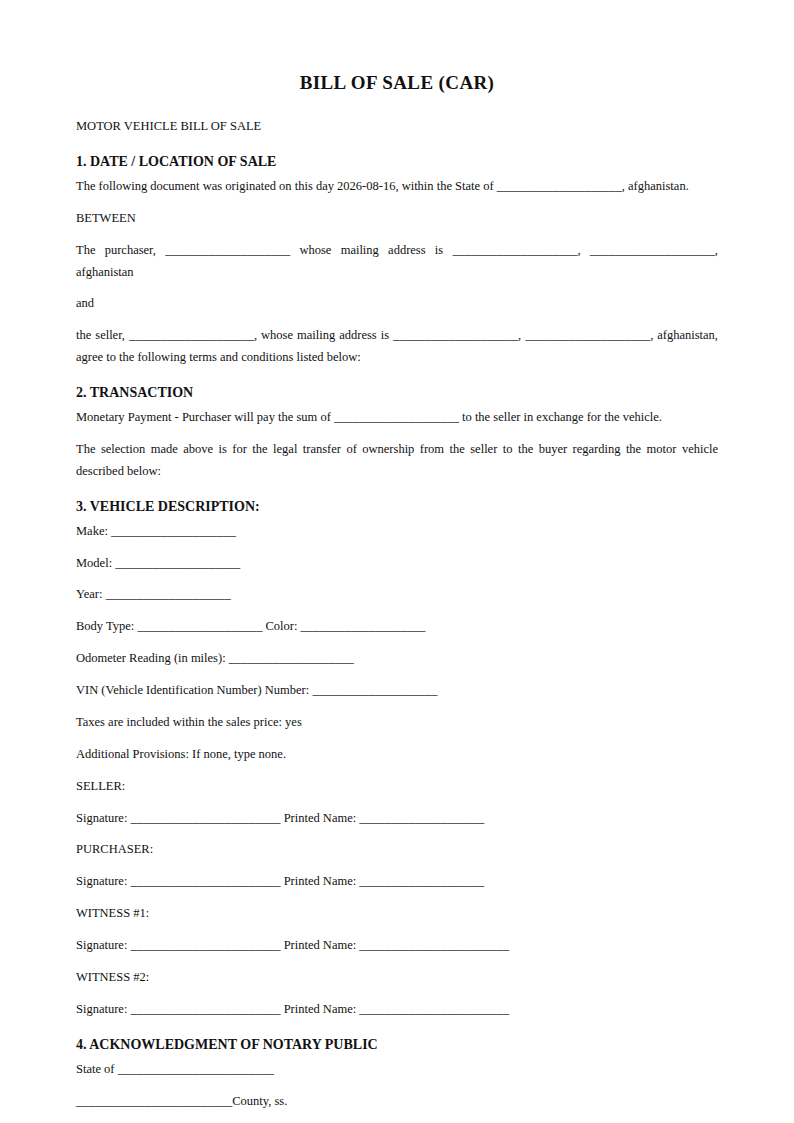
What a bill of sale (car) is
A bill of sale is the document recording that a vehicle has been sold from one person to another.
It identifies the car, the parties, the price and the date. It is the buyer's evidence of ownership until the registration is transferred, and it is the seller's evidence that they parted with the vehicle on a particular day.
That second function is the one sellers underestimate. Until the registration is changed, the vehicle remains recorded in the seller's name. Anything that happens with it, from a traffic offence to an accident to an abandoned vehicle, comes back to the person on the record. A dated bill of sale is what establishes that the car was no longer yours.
In Nigeria the sale is only half the job. The transfer has to be reflected with the licensing authority, and the vehicle papers handed over, or the buyer holds a car they cannot properly register and the seller holds a liability they thought they had sold.
Who needs one
Anybody selling or buying a used vehicle privately.
Sellers who want dated proof they no longer own a car, which matters more than most realise.
Buyers who need evidence of ownership while the registration transfer is processed.
Businesses disposing of fleet vehicles, where the record of disposal is also an accounting requirement.
Anybody buying a vehicle where the seller is not the registered owner, which is a situation calling for considerable care rather than a bill of sale alone.
Before you start
Do these checks before money changes hands.
Confirm the seller is the registered owner, by inspecting the vehicle papers and comparing them against their identification.
Check the chassis or vehicle identification number on the car matches the papers.
Establish whether the vehicle is subject to any finance or has been used as security.
Agree the price and what is included, such as spare keys and documents.
And read the odometer together, since it becomes part of the record.
The walkthrough
Filling in the form, step by step
Every question you will be asked, what it means, and an example of a good answer.
Step 1 of 5
Bill of Sale (Car)
The date and where the sale happens
The bill of sale opens with the date and location.
The date is the operative fact for the seller. It fixes the point from which the vehicle was no longer theirs, and it is the answer to any question about an incident afterwards. Use the actual date of handover rather than the date of the deposit or of the agreement to sell.
The country list includes Nigeria, so this form works for a Nigerian sale. Select Nigeria and give the state and city where the sale took place.
One word of caution about the tax question later in the form: it asks about sales tax, which is a US concept. Nigeria applies value added tax rather than sales tax, and a private sale between two individuals of a used vehicle is generally a different matter from a dealer sale. Where you are buying from a registered dealer, ask about VAT explicitly rather than assuming the price is inclusive.
- What is the date of the sale?
- The date the vehicle actually changes hands, not the date of the deposit or the agreement to sell. It fixes the point from which the seller is no longer responsible for the car.
- Country
- Where the sale takes place. Nigeria is in the list, so select it for a Nigerian sale rather than leaving the United States default in place.
- State/ City/ County
- The state and city of the sale, for example Lagos State, Ikeja. It records where the transaction happened, which matters if a dispute later arises about jurisdiction.
Step 2 of 5
Bill of Sale (Car)
The buyer
This step identifies the person acquiring the vehicle.
Name the buyer exactly as their identification does, because this name has to carry through to the registration transfer. A bill of sale in one spelling and a registration application in another creates a mismatch the licensing office will query.
The address matters for the same reason: vehicle registration is administered at state level in Nigeria, and the buyer's address determines where they will register it and which authority handles the transfer.
Buyers should take this moment seriously. Before completing, confirm the seller's name on the vehicle papers matches the person you are dealing with. Buying a car from somebody who is not the registered owner, without documentation explaining why, is how people acquire vehicles they cannot register and occasionally vehicles that were never the seller's to sell.
- Buyer Information
- The buyer's full name exactly as it appears on their identification, since this name carries through to the registration transfer and a mismatch will be queried.
- Address
- The buyer's residential address. Vehicle registration is administered at state level, so this determines where the transfer is processed.
- State/ City
- The buyer's state and city, which together with the address establishes the licensing authority that will handle the registration.
- Country
- The buyer's country. Select Nigeria for a Nigerian buyer rather than leaving a default in place.
Step 3 of 5
Bill of Sale (Car)
The seller
This step names the person disposing of the vehicle.
The seller's name should match the name on the vehicle papers. Where it does not, the sale needs explaining before it proceeds: an executor selling a deceased owner's car, a company disposing of a fleet vehicle, or somebody selling under a power of attorney all have legitimate documentation, and a seller with none of that is a serious warning sign.
For the seller, completing this properly is self protection. A bill of sale naming you, dated, and signed by an identified buyer is what you produce if the vehicle is later involved in something and the record still shows your name.
Keep a copy along with a photograph of the buyer's identification. Sellers who hand over a car and keep nothing have no way to demonstrate who took it.
- Seller Information
- The seller's full name, which should match the name on the vehicle papers. Where it does not, the basis for the sale needs documenting, whether that is probate, a company resolution or a power of attorney.
- Address
- The seller's residential address, recorded so the buyer can reach them if a question arises about the papers after the sale.
- State/ City
- The seller's state and city.
- Country
- The seller's country. Select Nigeria for a Nigerian seller.
Step 4 of 5
Bill of Sale (Car)
The price and the vehicle
This step records what was paid and identifies the car.
State the actual price. Understating it to reduce transfer charges is common and it works against the buyer, whose evidence of what they paid is capped at whatever the document says. If the sale later unwinds, or an insurance claim turns on value, the bill of sale is the record.
On the tax question, note that it is framed around sales tax, which is a United States concept. Nigeria applies value added tax, and a private sale of a used vehicle between individuals is treated differently from a dealer sale. If you are buying from a registered dealer, ask whether the price includes VAT rather than assuming.
The vehicle details should be copied from the papers rather than from observation. Make, model, year, body type and colour together identify the car, and each is checked against the registration when the transfer is processed. A colour recorded as silver on the papers and grey on the bill of sale is a small discrepancy that creates a query at the worst moment.
- How much is the vehicle being sold for?
- The actual price paid. Understating it to reduce transfer charges works against the buyer, whose proof of what they paid is limited to what this document says.
- Is sales tax included in the price?
- Whether tax is included. Note this question is framed around US sales tax; Nigeria applies value added tax, and a private sale between individuals is treated differently from a dealer sale. Ask a dealer explicitly whether VAT is included.
- Make of the vehicle
- The manufacturer, taken from the vehicle papers rather than from the badge, since papers and badging occasionally differ on imported vehicles.
- Model of the vehicle
- The model as recorded in the papers, including the variant where the papers give one.
- Year of the vehicle
- The year of manufacture from the papers. For imported vehicles this is frequently different from the year of first registration in Nigeria, and the papers are what count.
- Body type
- The body type, for example saloon, hatchback or sport utility. It is one of the details cross referenced against the registration record.
- Color of the vehicle
- The colour as recorded in the papers rather than as you would describe it. A car recorded as silver and described here as grey creates a query during the transfer.
Step 5 of 5
Bill of Sale (Car)
The identification number and the mileage
The final step records the two details that uniquely identify this vehicle and its condition.
The vehicle identification number, or chassis number, is the single most important entry in the whole document. It identifies this specific car and no other. Copy it from the vehicle itself as well as the papers and confirm the two match. A mismatch between the chassis number stamped on the car and the number on the papers is the clearest sign that something is wrong with the vehicle's history, and it is worth stopping the transaction over.
The odometer reading records the mileage at sale. The form asks for miles; Nigerian vehicles are commonly calibrated in kilometres, so state which unit you are recording. A reading in kilometres entered as miles overstates the distance by more than half.
Recording the mileage protects both sides. It gives the buyer a benchmark and it protects the seller against a later allegation that the odometer was tampered with, since the reading at the point of sale is documented and agreed.
- Vehicle identification number
- The chassis or vehicle identification number, copied from the vehicle itself and checked against the papers. A mismatch between the two is the clearest indication something is wrong with the vehicle's history, and it is worth stopping the sale over.
- Odometer reading (miles)
- The mileage at the point of sale. The field says miles, and Nigerian vehicles are commonly in kilometres, so state which unit you are recording. It protects the buyer with a benchmark and the seller against a later allegation of tampering.
- Additional provision
- Anything else agreed that the form has not asked about: which documents are handed over, whether the vehicle is sold as seen with no warranty, who holds the spare key, or any repair the seller has agreed to make before collection. If there is nothing, type none rather than leaving it blank.
Ready to make yours?
Answer those questions in the builder and download a finished bill of sale (car) in Word and PDF.
Start now, ₦5,000After you download it
Transfer the registration
The bill of sale is evidence of the sale, not a change of registration. Until the licensing authority records the buyer, the vehicle remains in the seller's name.
Hand over every document
Vehicle licence, proof of ownership, roadworthiness certificate, insurance papers and both sets of keys. A buyer missing papers cannot complete the transfer.
Both sides keep a signed copy
The seller needs it as proof of disposal, and the buyer needs it as proof of ownership until the registration catches up.
Seller should notify the insurer
Cancel or transfer the policy on the day of sale. A policy left running on a car you no longer own is a problem waiting for somebody else's accident.
Questions people ask
Does a bill of sale transfer ownership of a car in Nigeria?
It evidences the sale, and the registration must still be transferred with the licensing authority. Until that happens the vehicle remains recorded in the seller's name.
Why does the seller need a bill of sale?
Because until the registration changes, anything involving the vehicle comes back to the name on the record. A dated bill of sale is the seller's proof the car was no longer theirs.
What should I check before buying a used car?
That the seller is the registered owner, that the chassis number on the car matches the papers, that the vehicle is not subject to finance, and that all documents are present.
Should I state the real price?
Yes. Understating it to reduce transfer charges works against the buyer, whose proof of what they paid is limited to what the document records.
What if the seller is not the registered owner?
Ask why and see the documentation: probate, a company resolution or a power of attorney. A seller who cannot explain the discrepancy is a serious warning sign.
Is the odometer reading in miles or kilometres?
The field says miles and most Nigerian vehicles read in kilometres, so state the unit. Recording kilometres as miles overstates the distance by more than half.
Documents that go with this
Terms used on this page
Sale of Goods
A sale of goods is a contract to transfer ownership of moveable property for a price. Nigerian law implies terms about title, description and quality that a seller cannot always contract out of.
Ownership
Ownership is the greatest interest a person can hold in property. For Nigerian land it is qualified, because the Land Use Act vests land in the state and what you actually hold is a right of occupancy.
Warranty
A warranty is a promise in a contract that something is true. If it turns out not to be, the other side can claim damages, though usually not walk away from the deal.
Consumer Protection
Consumer protection law gives buyers rights against sellers: honest information, safe goods, and redress when something is wrong. In Nigeria it is enforced by the FCCPC.
Deposit
A deposit is money paid to secure a transaction. Whether you get it back if the deal falls through depends on whether it was a true deposit or a part payment, and most people never ask.
Value Added Tax (VAT)
VAT is a consumption tax added to the price of most goods and services. Businesses collect it from customers and remit it to the FIRS, so it passes through the business rather than costing it.
Hire Purchase
Hire purchase is buying something by instalments while the seller keeps ownership until the final payment. You are hiring the item until the last instalment clears, then it becomes yours.
Title Search
A title search is the check you run at the lands registry before buying land, to find out who actually owns it and what is registered against it. It is the cheapest part of any Nigerian property purchase.
Read more on this
Importance and Benefits of a Purchase Order
Importance and Benefits of a Purchase Order: Serious Businesses Use It — You Should Too In the early stages of running a business, many entrepreneurs rely on informal arrangements when buying goods or services. A quick p…
What Should I Write in My Terms and Conditions? Guide and Template
What Should I Write in My Terms and Conditions Most people see terms and conditions as a long legal document sitting at the bottom of a website. Many users click “agree” without reading it. Yet behind that simple checkbo…
How to Write a Demand Letter That Actually Gets You Paid (With a Template)
Step by step guides for every document on LegalDoc
Browse all guides