
How to Write a Demand Letter
A demand letter is the formal request that comes before a lawsuit. Most debts are recovered at this stage, which is why it is worth writing properly.
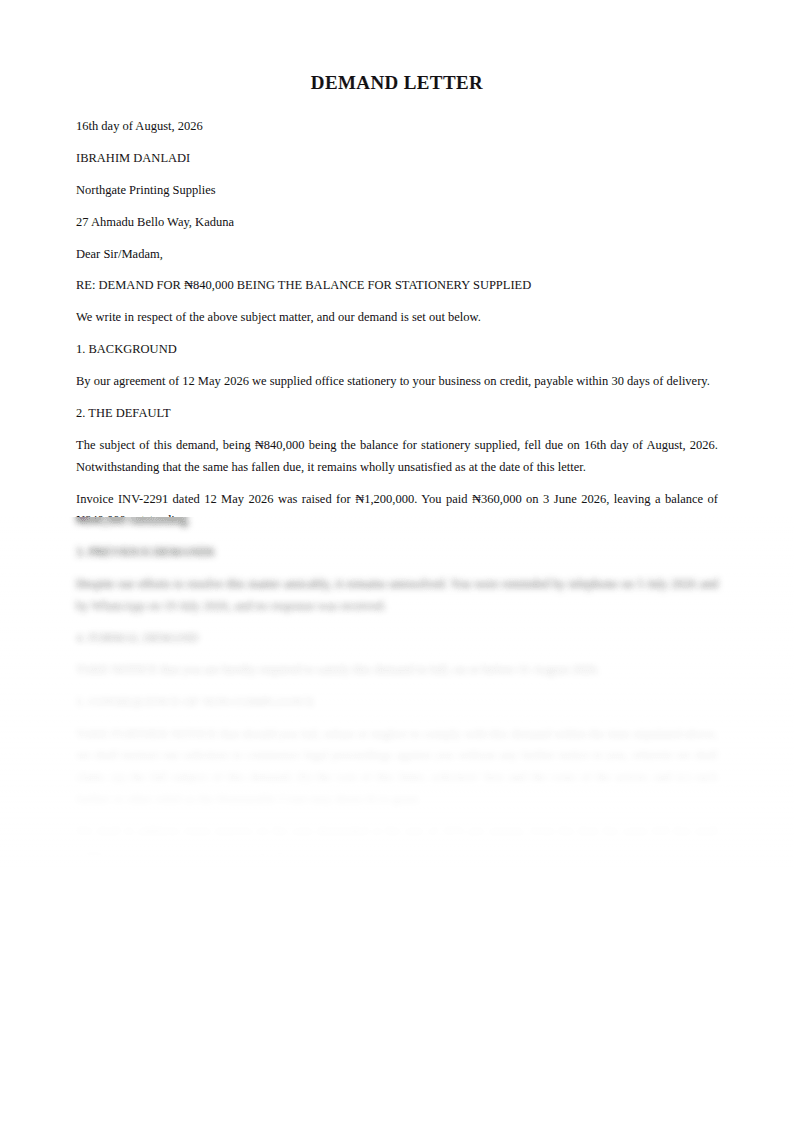
What a demand letter is
A demand letter is a formal written request that somebody pay what they owe or do what they agreed to do.
It does three things. It puts the other side on notice that you are serious. It creates a dated record of the debt and of your attempt to resolve it without court. And it gives them a final chance to settle before you incur the cost of proceedings.
That middle function matters more than people realise. A demand letter sent, ignored, and later produced in court tells a story: the claimant behaved reasonably and the defendant did not engage. Courts notice.
The practical reality is that most debts are recovered at this stage. A properly written demand letter, from somebody who clearly intends to follow through, resolves more disputes than any subsequent step.
Who needs one
Businesses chasing unpaid invoices, which is the most common use by a wide margin.
Anybody owed money by a person or company who has stopped responding to informal requests.
People whose property is being held by somebody with no right to keep it, where the demand is for return rather than payment.
Parties who need to demonstrate they attempted resolution before starting a claim, which is expected in most Nigerian courts and required by some pre action protocols.
It is also the step before the small claims court, where the process is designed for exactly this kind of dispute.
Before you start
Assemble the evidence before you write, because a demand supported by documents is a different letter from one that is not.
The agreement, whether written, an exchange of messages, or a course of dealing.
Invoices, delivery notes and receipts.
A record of what has been paid and what remains.
Dates of previous requests, including calls and messages.
And a decision about what you will actually do if they ignore this, since a threat you will not follow through on is worth nothing the second time.
The walkthrough
Filling in the form, step by step
Every question you will be asked, what it means, and an example of a good answer.
Step 1 of 4
Demand Letter
What you are owed and why
This step establishes the claim, and specificity is what makes it credible.
State the amount precisely rather than approximately. Eight hundred and forty thousand naira being the balance on invoice INV-2291 is a claim somebody can check and either pay or dispute. Money you owe me for the stationery is an invitation to argue about how much.
The summary of the agreement is where you show there was an obligation at all. Give the date, what was agreed, and on what terms. Where the agreement was verbal or by messages, say so honestly and describe what was said, because a demand that overstates the formality of an arrangement is easily challenged.
The choice between payment and action changes the letter. A demand for money is straightforward. A demand for the return of goods or performance of an obligation needs to describe exactly what must be done and by when, since the recipient has to know what compliance looks like.
- Amount / what is being demanded
- The amount owed or the thing to be returned or done, stated precisely. A specific figure tied to an invoice can be checked and paid; a general reference to money owed just starts an argument about the number.
- Date it became due
- When the obligation fell due. It matters for two reasons: it shows how long the default has run, and it starts the clock for any interest claim and for the limitation period.
- What was agreed between you?
- What was agreed between you, with the date and the terms. Where the agreement was verbal or by message rather than a signed contract, describe it honestly, since overstating its formality is easy to challenge.
- Is your demand for payment, or for something to be done?
- Choose which this is. A demand for payment is straightforward. A demand for an action needs to describe exactly what compliance looks like, so the recipient knows what will satisfy you.
- Give the details of the money owed
- The detail of the money owed: the invoice number and date, the original amount, anything paid, and the balance. Showing the arithmetic makes the claim verifiable rather than assertive.
- Give the details of what must be done
- The detail of what must be done, identified precisely. Return the generator, serial number GX-88421, held since 3 June 2026, is enforceable. Return my property is not.
Step 2 of 4
Demand Letter
Who you are writing to
This step names the recipient, and getting it right is more consequential than it looks.
The critical question is whether you are demanding from an individual or a company. If the debt is owed by a registered company, address the company, because that is the party liable and the one you would sue. Writing to a director personally about a company debt confuses the position and can be dismissed on that basis.
The reverse also applies. If somebody traded with you personally, without a company, then the individual is your debtor and naming a business that does not legally exist weakens the letter.
Check the CAC record if you are unsure. It costs little and it tells you the registered name and address, which is also where formal correspondence should be sent.
- Who are you writing to? (their full name)
- The full name of the person you are writing to. Where the debt is owed by a company, this is the contact you are addressing, and the company itself is named below as the party liable.
- Their company or business name (if any)
- Their company or business name, if the debt is owed by a business rather than an individual. Use the registered name from the CAC record, since that is the entity you would ultimately sue.
- Their address
- Their address for service. For a company, the registered office is the safe choice, because that is where formal correspondence is deemed to reach them.
Step 3 of 4
Demand Letter
Who you are
This step identifies you as the creditor and gives them a route to settle.
Name the correct claimant. If your company supplied the goods, the company is owed the money and should be the one demanding it, not you personally. Getting this wrong at the demand stage produces an inconsistency between the letter and any claim that follows.
Contact details deserve more thought than they usually get. A meaningful proportion of demand letters are answered by somebody who wants to pay in instalments or query one item, and if they cannot reach you easily they simply do not. Give a phone number and an email, and make sure both are monitored while the deadline runs.
- Your name
- Your full name. Where the debt is owed to your business rather than to you personally, your name here is as the person writing on the company's behalf.
- Your company name (if you are writing as a business)
- Your company name, where the business is the creditor. Name the entity that actually supplied the goods or services, since that is the party entitled to the money and the one that would bring a claim.
- Your address
- Your address, which is where any reply or payment arrangement will be directed.
- Your phone number and/or email
- A phone number and email you will actually monitor. A good proportion of demand letters are answered by somebody wanting to negotiate, and an unreachable creditor gets no reply at all.
Step 4 of 4
Demand Letter
The deadline, the history and interest
The final step is what turns a complaint into a demand.
Set a specific date, not a period. By 31 August 2026 is unambiguous. Within a reasonable time is not, and it removes the pressure the letter is supposed to create. Seven to fourteen days is a common and defensible window for a straightforward debt.
The record of previous attempts is the part most people skip and it is quietly the most powerful paragraph in the letter. Reminded by telephone on 5 July and by message on 19 July, with no response received, establishes a pattern of avoidance. It also protects you against the defence that they never knew about the debt.
On interest, you can only claim it if there is a basis: a contract term providing for it, or a statutory or equitable entitlement. Where your invoice terms specify a rate, state it. Where nothing was agreed, be careful about asserting a figure you cannot support, because an overstated claim gives the other side something to attack instead of the debt itself.
- Deadline for them to comply
- A specific date by which they must comply, for example 31 August 2026. Seven to fourteen days is common and defensible for a straightforward debt. A vague reference to a reasonable time removes the pressure the letter exists to create.
- Date of this letter
- The date of the letter. Keep it consistent with when you actually send it, since the deadline is counted from here and a stale date invites a dispute about whether the notice was fair.
- Have you already asked them? Give details
- Every earlier request, with dates and method: calls, messages, emails. This is the paragraph that establishes a pattern of avoidance and defeats any suggestion they were unaware of the debt.
- Interest rate to claim (% per year)
- The rate you are claiming, if you have a basis for it. A contract or invoice term providing for interest is the strongest ground. Asserting a rate you cannot support gives the other side something to attack instead of the debt.
Ready to make yours?
Answer those questions in the builder and download a finished demand letter in Word and PDF.
Start now, ₦5,000After you download it
Send it so delivery can be proved
Email with a read receipt, a courier with tracking, or hand delivery with an acknowledgement. A demand you cannot show was received does much less work later.
Keep the deadline
If you said 31 August and take no action until November, the next demand carries less weight. Follow through or do not set the date.
Consider the small claims court
For modest sums, small claims procedures are quicker and cheaper than ordinary litigation, and a demand letter is normally the step that precedes filing.
Be open to a payment plan
Recovering most of the money over three months usually beats winning a judgment you then have to enforce. Record any arrangement in writing.
Questions people ask
What is a demand letter?
A formal written request that somebody pay what they owe or do what they agreed. It creates a dated record, puts the other side on notice, and gives them a final chance before proceedings.
How long should I give them to respond?
Seven to fourteen days is common and defensible for a straightforward debt. Set a specific date rather than a vague period, because a deadline you can point to is what creates pressure.
Can I claim interest on an unpaid debt?
Only with a basis for it, such as a contract or invoice term providing for interest. Asserting a rate you cannot support gives the other side something to argue about instead of the debt.
Should I write to the company or the person?
Whoever owes the money. If a registered company incurred the debt, address the company, since that is the party you would sue. Writing to a director personally about a company debt muddles the position.
Do I need a lawyer to send a demand letter?
No, though a letter from a lawyer sometimes prompts faster payment. What matters most is that the claim is specific, supported by documents, and followed by action if ignored.
What if they ignore it?
Follow through. Depending on the sum, that may mean the small claims court or ordinary proceedings. A demand letter that is never acted on teaches the debtor that the next one can be ignored too.
Documents that go with this
Terms used on this page
Demand Letter
A demand letter is a formal written request for payment or action, sent before you take legal steps. In Nigeria it is usually the cheapest and fastest way to get somebody to take you seriously.
Bad Debt
A bad debt is money owed that will not be collected. Writing it off is an accounting step, and claiming it as a tax deduction has conditions that must be satisfied.
Limitation Period
A limitation period is the deadline for bringing a claim to court. Once it passes, the claim is statute barred, and it will be struck out however strong it was on the facts.
Small Claims Court
A small claims court recovers modest debts quickly and cheaply, without needing a lawyer. Lagos runs one and several other states have followed, and most Nigerians have never heard of it.
Interest
Interest is the price of money over time. Whether you can charge it on a debt, and at what rate, depends almost entirely on what the contract says.
Breach of Contract
A breach of contract happens when one side fails to do what the agreement says they would do. The other side can then claim damages, and in serious cases walk away from the contract entirely.
Cause of Action
A cause of action is the set of facts that gives you a right to sue. Without one, a claim is struck out however genuine the grievance behind it.
Garnishee
A garnishee is a third party, usually a bank, ordered by a court to pay a judgment debtor's money to the judgment creditor instead. It is the most effective way to enforce a money judgment in Nigeria.
Read more on this
How to Write a Demand Letter That Actually Gets You Paid (With a Template)
How to Terminate a Contract the Right Way
How to Terminate a Contract the Right Way How do you end a contract properly without creating bigger problems? Because terminating a contract is not just about walking away. If done carelessly, it can expose you to claim…
The Importance of a Dispute Resolution Clause in a Loan Agreement
The Importance of a Dispute Resolution Clause in a Loan Agreement One party needs funds. The other is willing to provide it. The terms are discussed, repayment is scheduled, and both sides expect everything to go accordi…
Step by step guides for every document on LegalDoc
Browse all guides