
How to Write a Loan Agreement
Money lent to a friend or a business without a written agreement is money you may not see again. This is the document that changes that.
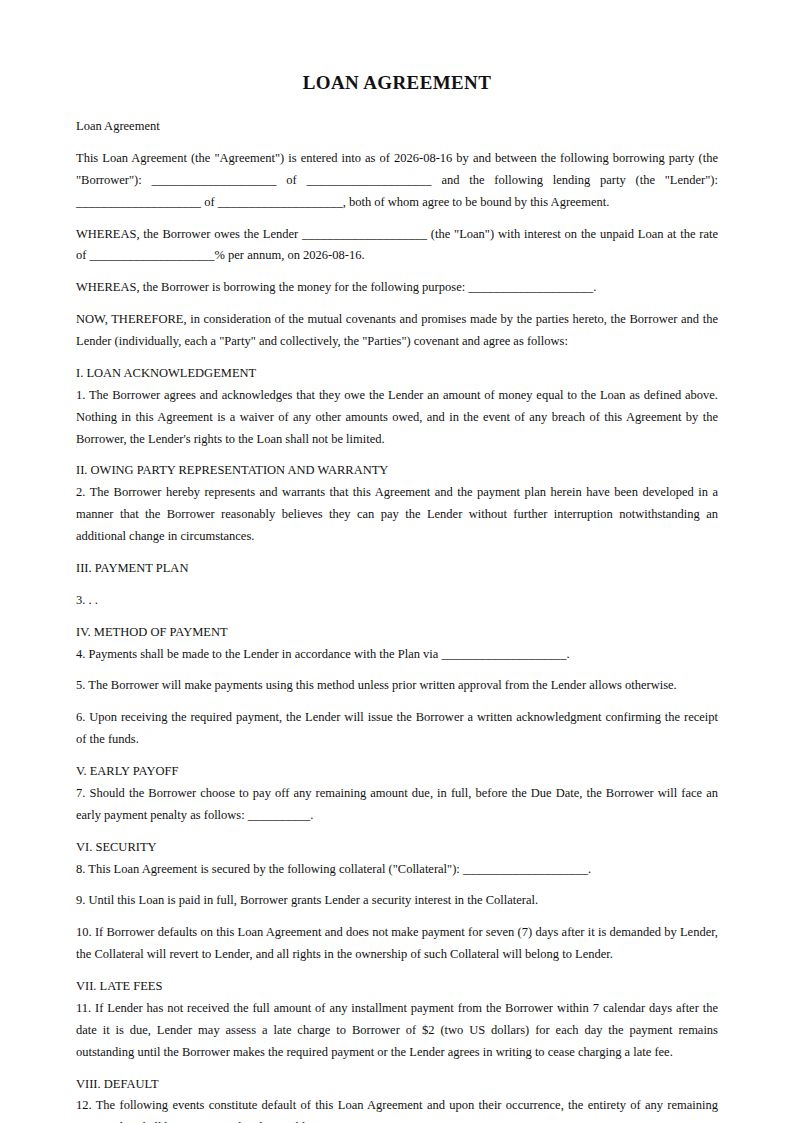
What a loan agreement is
A loan agreement records money lent by one party to another and the terms on which it must be repaid.
It states the amount, any interest, when repayment is due, and how it will be made. Where security is given, it says what.
The reason it matters is evidential. Most money lent between individuals and small businesses in Nigeria moves on trust and a bank transfer, and when repayment stops the lender discovers they have a transfer receipt and nothing else. A receipt proves money moved; it does not prove the money was a loan rather than a gift, an investment or payment for something.
A written agreement removes that argument entirely. It also gives the borrower certainty about what is owed and when, which protects them from a lender who later remembers the terms more favourably.
Who needs one
Anybody lending money to family, friends or acquaintances, which is where most disputes originate.
Businesses lending to or borrowing from directors, shareholders or related companies, where the tax and accounting position needs the arrangement documented.
Informal lenders and cooperative societies.
Borrowers who want the terms fixed rather than left to a lender's recollection.
Where the borrower is a company and you want a director personally on the hook, a separate personal guarantee is the instrument for that, since a loan to a company reaches only the company.
Before you start
Settle these before drafting.
The amount, and whether it is advanced in one payment or in tranches.
Whether interest is charged and at what rate.
When repayment is due, and whether it is a single payment or instalments.
Whether any security is given, and whether that security actually exists and is unencumbered.
And honestly, whether the borrower can repay, since a loan agreement improves your evidence and does not improve their capacity to pay.
The walkthrough
Filling in the form, step by step
Every question you will be asked, what it means, and an example of a good answer.
Step 1 of 4
Loan Agreement
The parties and the date
The agreement names the lender and the borrower.
Be precise about who the borrower actually is. Lending to a person is different from lending to their company. If the money goes to a company, the company owes it, and the director behind it does not, however involved they were in asking. Lenders discover this at the point the company has no assets.
If you want the individual liable as well, that requires either lending to them personally or taking a separate personal guarantee. It is a conversation worth having before the money moves rather than afterwards.
Addresses matter for service. A borrower who moves without telling you is a common problem, and a demand letter sent to an address they left two years ago does very little.
- Agreement Date
- The date the agreement is made. Where money has already been advanced informally, use the honest date and record when the funds were actually provided, since that is when the obligation began.
- Borrower's Name
- Who is borrowing, and be precise. A loan to a company reaches only the company, not the director who asked for it. If you want the individual liable too, lend to them personally or take a separate personal guarantee.
- Borrower's Address
- The borrower's address for service. A borrower who moves without telling the lender is a common problem, and a demand sent to a stale address achieves very little.
- Lender's Name
- Who is lending. Where the money comes from a business rather than an individual, name the business, since that is the party entitled to repayment and the one that would sue.
- Lender's Address
- The lender's address, where repayments and correspondence are directed.
Step 2 of 4
Loan Agreement
The amount, the interest and the deadline
This step sets the commercial terms.
State the amount in figures and words. It removes the ambiguity that a mistyped digit creates in a document nobody re reads until there is a dispute.
On interest, be specific about the rate and the period: ten per cent per annum is clear, ten per cent is not, because it could mean per annum, per month or a flat charge. That difference is enormous over a year and it is precisely the kind of ambiguity a court has to resolve.
Be aware that a rate set far above market can attract scrutiny as unconscionable, particularly between unequal parties, and a lender relying on an extreme rate may find it reduced.
The repayment date is what makes the debt enforceable. Until money is due, it cannot be demanded, and the limitation period generally runs from the date the cause of action arose. A loan with no repayment date is repayable on demand, which sounds convenient and is considerably harder to prove.
The purpose is worth stating. It evidences that this was a loan rather than a gift, which is the single most common defence a borrower raises.
- Loan Amount
- The principal, in figures and in words. Writing it twice removes the ambiguity a mistyped digit creates in a document nobody rereads until there is an argument about it.
- Interest Rate
- The rate and, critically, the period: ten per cent per annum rather than ten per cent. The difference between per annum and per month is enormous, and an unstated period is exactly what gets litigated.
- Repayment Date
- When repayment falls due. This is what makes the debt enforceable, since money cannot be demanded before it is due. A loan with no date is repayable on demand, which is harder to prove than a fixed date.
- Purpose of Loan
- What the money is for. It evidences that this was a loan rather than a gift, which is the most common defence a borrower raises when repayment is demanded.
Step 3 of 4
Loan Agreement
How it is repaid
This step covers the repayment structure, and instalments are usually the more realistic choice.
A single payment suits a short term loan where the borrower expects a specific inflow. It carries an obvious risk: nothing is repaid until the end, so the lender learns whether the borrower can pay only at the moment the whole sum falls due.
Instalments spread that risk and give early warning. A borrower who misses the second of twelve payments has told you something useful while eleven payments remain, and a lender can act on it. Instalments also suit a borrower repaying out of income rather than a windfall.
Complete only the boxes matching your choices. For instalments, state the amount of each payment, the day it falls due, and the number of payments, so the schedule is calculable rather than approximate.
Worth adding, since the form does not ask: what happens on default. Whether the whole balance becomes payable on a missed instalment, and what interest applies to arrears. Without an acceleration clause, a lender faced with a defaulting borrower can only claim the instalments that have actually fallen due.
- Payment Plan
- Whether the loan is repaid in one payment or over time. A single payment suits a short term loan against an expected inflow; instalments suit repayment out of income and give earlier warning of trouble.
- Single Payment
- If a single payment, state the amount and the date. Note that the lender learns whether the borrower can pay only when the whole sum falls due, which is late to find out.
- Reoccurring Payment
- If recurring, describe the arrangement: the amount of each payment, when they run from and to, and the total number. A schedule that can be calculated is far easier to enforce than one that is described loosely.
- Installment
- The instalment frequency. Match it to how the borrower is actually paid, since monthly instalments from somebody paid monthly are far more reliably met than quarterly ones they must save for.
- Monthly
- If monthly, state the amount of each instalment, the day of the month it is due, and how many payments there are in total.
- Quarterly
- If quarterly, state the amount, the due dates and the number of payments. Quarterly repayment asks the borrower to hold money for three months, which is harder than it sounds.
- Annually
- If annual, state the amount and the due date each year. Long gaps between payments carry the most risk, since a great deal can change in a borrower's circumstances over twelve months.
Step 4 of 4
Loan Agreement
Security, payment method and governing law
The final step deals with what backs the loan and how it is paid.
Collateral is what turns an unsecured promise into something you can realise. State precisely what it is: a vehicle by its chassis number, property by its address and title reference, equipment by serial number. Then verify it, because security that turns out to belong to somebody else, or to be mortgaged already, is no security at all.
There is a further point Nigerian lenders regularly miss. Taking security over property or over a company's assets usually requires steps beyond writing it in the agreement: registering a charge, perfecting an interest, or holding title documents. An agreement saying the borrower's car secures the loan, with the car still registered and possessed by the borrower, gives you very little when they sell it.
On payment method, name a bank account and require transfers. Cash repayments create the same evidential problem the agreement exists to solve, and a borrower who claims to have repaid in cash is difficult to contradict.
Name a Nigerian state connected to the parties, since enforcement means going to court there.
- Collateral (if any)
- What secures the loan, described precisely: a vehicle by chassis number, property by address and title reference, equipment by serial number. Verify it exists and is unencumbered, and note that taking effective security usually requires more than naming it here, such as registering a charge or holding title documents.
- Payment Method
- How repayments are made, for example bank transfer to a named account. Require transfers rather than cash, since cash repayments recreate exactly the evidential problem this agreement exists to solve.
- The Agreement is to be governed by the laws of which state?
- The Nigerian state governing the agreement, for example Lagos State. Choose somewhere connected to the parties, since enforcing an unpaid loan means bringing a claim there.
Ready to make yours?
Answer those questions in the builder and download a finished loan agreement in Word and PDF.
Start now, ₦10,000After you download it
Transfer the money traceably
Bank transfer with a reference matching the agreement. The transfer record and the agreement together are what prove both the loan and its terms.
Perfect any security properly
Naming collateral in the agreement is not the same as holding it. Registering a charge or taking title documents is what makes security worth having.
Add an acceleration clause
The form does not ask. Without one, a missed instalment lets you claim only the payments already due rather than the whole outstanding balance.
Act early on default
A demand letter after the first missed payment is far more effective than one sent a year later. Delay weakens both recovery and credibility.
Questions people ask
Do I need a written loan agreement in Nigeria?
You are not required to have one, but without it you have a transfer receipt proving money moved, not proving it was a loan. That distinction is what most disputes turn on.
How should I state the interest rate?
With the period attached: ten per cent per annum rather than ten per cent. The difference between per annum and per month is enormous and an unstated period is what gets argued about.
Can I lend to a company and hold the director liable?
Not automatically. A loan to a company reaches only the company. If you want the director liable too, take a separate personal guarantee or lend to them personally.
Is naming collateral enough to secure a loan?
Usually not. Effective security generally requires further steps such as registering a charge or holding title documents. Collateral named in an agreement but left with the borrower is easily sold.
What if the borrower misses a payment?
That depends on whether the agreement has an acceleration clause. Without one you can claim only the instalments already due, not the whole outstanding balance.
Should repayments be in cash?
No. Use traceable bank transfers. Cash repayments recreate exactly the evidential problem the written agreement exists to solve, and are difficult to disprove.
Documents that go with this
Terms used on this page
Loan Agreement
A loan agreement is the contract between a lender and a borrower setting out how much is lent, what it costs, when it comes back and what happens if it does not. It is the document most Nigerian lending goes wrong without.
Interest
Interest is the price of money over time. Whether you can charge it on a debt, and at what rate, depends almost entirely on what the contract says.
Collateral
Collateral is an asset a borrower pledges so the lender has something to fall back on. If the loan is not repaid, the lender can realise the asset instead of chasing an empty promise.
Personal Guarantee
A personal guarantee is a promise to pay somebody else's debt if they do not. It is what Nigerian banks ask directors for, and it puts personal assets behind a company obligation.
Guarantor
A guarantor promises to pay somebody else's debt or perform their obligation if they fail to. Signing as one makes you liable for a debt you did not benefit from.
Bad Debt
A bad debt is money owed that will not be collected. Writing it off is an accounting step, and claiming it as a tax deduction has conditions that must be satisfied.
Default Judgment
A default judgment is entered when a defendant does not respond in time. It is a real judgment, enforceable immediately, and it can usually be set aside if you move quickly with a genuine defence.
Limitation Period
A limitation period is the deadline for bringing a claim to court. Once it passes, the claim is statute barred, and it will be struck out however strong it was on the facts.
Read more on this
Why Every Loan Should Have a Proper Loan Agreement
Protecting the Lender and the Capital: Why Every Loan Should Have a Proper Loan Agreement Lending money to a friend, a business partner, or a small enterprise often begins with trust. In Nigeria, informal lending arrange…
The Importance of a Dispute Resolution Clause in a Loan Agreement
The Importance of a Dispute Resolution Clause in a Loan Agreement One party needs funds. The other is willing to provide it. The terms are discussed, repayment is scheduled, and both sides expect everything to go accordi…
How to Write a Demand Letter That Actually Gets You Paid (With a Template)
Step by step guides for every document on LegalDoc
Browse all guides