
How to Write a Purchase Order
A purchase order is the buyer's formal instruction to a supplier. Accepted, it becomes a contract, which is why the numbers on it matter.
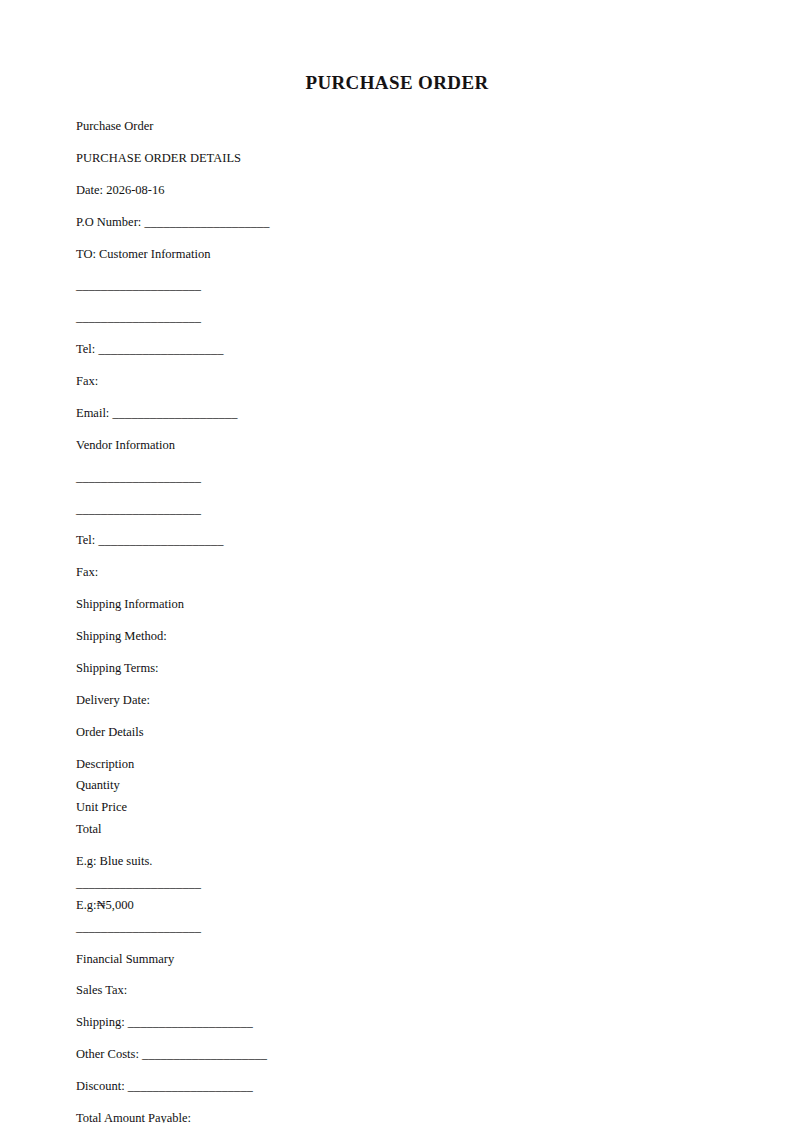
What a purchase order is
A purchase order is a document a buyer issues to a supplier, setting out exactly what is being ordered, at what price, and on what terms.
It is more than paperwork. A purchase order is an offer, and once the supplier accepts it, there is a contract on those terms. That is why the numbers on it matter: the price, quantity and delivery date on an accepted purchase order are what both sides are bound to.
It also creates the control that businesses need as they grow. When every purchase runs through a numbered order, you can match the invoice to the order and the delivery note, and you find out about overcharging before you pay rather than afterwards.
For the supplier, a purchase order is the authority to supply. Delivering goods without one, on somebody's word, is how suppliers end up unpaid and arguing about whether the order was ever placed.
Who needs one
Businesses buying goods or services from suppliers on any regular basis.
Companies introducing purchase controls, where the order number becomes the reference for matching invoices and deliveries.
Suppliers who want written authority before shipping, particularly to a new customer or on credit.
Anybody who has paid an invoice for more than they thought they ordered, which is the problem this document exists to prevent.
For a one off sale of specific goods between two parties, a sale of goods agreement covers the ground more fully.
Before you start
Have the commercial detail settled.
Exactly what you are ordering, in the supplier's own description and codes where you have them.
The agreed unit price, and whether it includes VAT.
The quantity and the delivery date you actually need.
Whether the supplier is shipping or you are collecting, and who bears that cost.
And your own order numbering, since the number is what makes the document useful for matching later.
The walkthrough
Filling in the form, step by step
Every question you will be asked, what it means, and an example of a good answer.
Step 1 of 4
Purchase Order
The order, the customer and the vendor
The first step identifies the order and both parties.
The purchase order number is the part people treat casually and should not. It is the reference that ties this order to the supplier's invoice, the delivery note and your payment. Without a unique number, matching becomes guesswork the moment you have more than a handful of orders open.
Use a system rather than a random figure. Sequential numbering, optionally with a year or department prefix, makes gaps visible and makes it obvious when an invoice arrives quoting a number nobody issued.
Name both businesses properly. The customer is the entity that will pay, and the vendor is the entity that will invoice. Where a supplier trades under a name different from their registered one, use the registered name, since that is who you are contracting with and who you would pursue.
- Order Date
- The date you issue the order. Delivery timelines are usually counted from here, and it is the reference point if the supplier later claims the order arrived at a different time.
- Purchase Order No.
- Your own reference for this order. Use sequential numbering rather than an arbitrary figure, since this number ties the order to the invoice, the delivery note and the payment, and gaps in a sequence are visible.
- Customer's Name
- The buying entity, using its registered name. This is the party that will pay the invoice and the one bound by the order once the supplier accepts it.
- Customer's Address
- The buyer's address. Where goods are being delivered somewhere else, note the delivery address separately in the special instructions, since this is the billing address.
- Customer's Phone No.
- A number the supplier can reach you on about the order. Queries about stock and delivery arrive at short notice and unanswered ones become delays.
- Customer's Email
- The email for order correspondence and the invoice. An accounts address rather than a personal one keeps the paperwork where it belongs when staff change.
- Vendor's Name
- The supplier, using their registered name rather than a trading name. That is the entity you are contracting with and the one you would pursue if the goods never arrive.
- Vendor's Address
- The supplier's business address, which should match the one on their invoices. A mismatch between the two is worth querying before you pay anything.
- Vendor's Phone
- The supplier's contact number for this order, ideally the person handling it rather than a general line.
Step 2 of 4
Purchase Order
Shipping and delivery
This step covers how the goods reach you and when.
The shipping terms question is doing more work than its size suggests. It determines who arranges transport, who pays for it, and at what point risk passes from supplier to buyer. If the goods are damaged in transit, the answer to who bears that loss is in these terms.
Where you are importing, this is where an Incoterm belongs, and it should be stated with the named place and the edition. Ex works means you collect from their premises and everything after that is your cost and your risk. Delivered duty paid means the supplier handles everything including customs. Those are very different prices for the same goods.
The delivery date should be the date you actually need, and it becomes a contractual term once the order is accepted. If the timing genuinely matters, say so, since a supplier who knows the date is critical will tell you when they cannot meet it.
- Will this order be Shipped?
- Choose Yes if the supplier is delivering, No if you are collecting. It determines who arranges and pays for transport, and it affects when responsibility for the goods passes to you.
- Shipping Method
- How the goods travel, for example by road courier or the supplier's own vehicle. For imports, name the mode and the route, since it affects both timing and cost.
- Shipping Terms
- Who bears the cost and the risk in transit. For an import, state the Incoterm with the named place and the edition, for example CIF Lagos, Incoterms 2020. This clause answers who carries the loss if goods are damaged on the way.
- Delivery Date
- When you need the goods. Once the supplier accepts the order this becomes a contractual date, so state what you actually need rather than an optimistic one, and say if the timing is critical.
Step 3 of 4
Purchase Order
What you are ordering
This step is the substance of the order and it rewards precision.
Describe the goods using the supplier's own product description and code where you have one. Blue suits is a description that leads to an argument about shade, size and fabric. The supplier's catalogue reference does not.
Quantity and unit price should be stated separately, with the total shown, because that is what allows the invoice to be checked. An invoice quoting only a total tells you nothing about whether they billed the agreed rate.
Be explicit about whether the unit price includes VAT. Nigerian suppliers quote both ways, and an order that does not say produces an invoice seven and a half per cent higher than the buyer expected, which is a conversation nobody enjoys having after delivery.
- Order Description
- What you are ordering, using the supplier's own description and product code where you have one. A precise reference removes the argument about specification that a general description invites.
- Quantity
- How many units. State the unit of measure as well where it could be ambiguous, since cartons, packs and individual items are easily confused between buyer and supplier.
- Unit Price
- The agreed price per unit. Say explicitly whether it includes VAT, because Nigerian suppliers quote both ways and an unstated assumption produces an invoice higher than the buyer expected.
- Total
- Quantity multiplied by unit price. Showing the arithmetic is what lets you check the invoice against the order rather than taking the supplier's total on trust.
Step 4 of 4
Purchase Order
Tax, extras and the grand total
The final step assembles the full cost, and the VAT line is the one to get right.
Value added tax applies to most goods and services in Nigeria at the standard rate, with exemptions for certain items. Where your supplier is registered for VAT they will charge it, and it should appear as a separate line rather than being absorbed into the unit price, both so you can check it and so you can claim it where you are entitled to.
Shipping and other costs belong here rather than being discovered on the invoice. A supplier who adds a delivery charge that was never in the order has changed the price, and an order that stated the shipping cost gives you the basis to say so.
The grand total is what you are authorising. Whoever approves this order is approving that figure, which is the point of the document as a financial control.
Special instructions is the free text box, and it is where a delivery address different from the billing address belongs, along with packaging requirements, site access details or anything else the supplier needs to know.
- Value Added Tax
- The VAT on the order, shown as a separate line. Most goods and services in Nigeria attract VAT at the standard rate, and separating it lets you verify the charge and claim it where you are entitled.
- Shipping Cost
- The delivery charge, agreed in advance. A supplier who adds this at invoice stage has changed the price, and stating it here is what gives you the ground to query it.
- Any other Cost?
- Anything else the supplier will charge: packaging, installation, handling, insurance. Costs that appear only on the invoice are the most common source of purchase order disputes.
- Discount
- Any agreed reduction, whether a trade discount, a volume rate or a settlement discount for prompt payment. Recording it prevents an invoice arriving at list price.
- Grand Total
- The full amount payable including tax and extras. This is the figure being authorised, and it is the number the eventual invoice should match.
- Any Special Instruction?
- Anything the supplier needs to know: a delivery address different from the billing address, site access arrangements, packaging requirements, or a contact to call before delivery.
Ready to make yours?
Answer those questions in the builder and download a finished purchase order in Word and PDF.
Start now, ₦2,000After you download it
Get it acknowledged
A purchase order is an offer until the supplier accepts it. A written acknowledgement confirms the contract exists on your terms rather than theirs.
Match invoice, order and delivery note
Three way matching is the control the order number exists for. Check all three before paying, since that is when overcharging is easiest to correct.
Watch the supplier's own terms
Suppliers often respond with an acknowledgement carrying their standard terms. Where those differ from your order, resolve it before delivery rather than after.
Keep the numbering sequential
Gaps and duplicates in order numbers defeat the purpose. A simple sequence, with a prefix if you need one, is enough.
Questions people ask
Is a purchase order a contract?
It is an offer, and it becomes a contract once the supplier accepts it. The price, quantity and delivery date on an accepted order are binding on both sides.
What is the difference between a purchase order and an invoice?
The buyer issues the purchase order to say what they want. The supplier issues the invoice to request payment for what they supplied. Matching the two is the control.
Should the unit price include VAT?
Say either way, but say. Nigerian suppliers quote both inclusive and exclusive, and an order that leaves it unstated produces an invoice higher than the buyer expected.
Who pays for shipping?
Whoever the shipping terms say. For imports, state the Incoterm with the named place and edition, since that also determines who bears the risk if goods are damaged in transit.
What if the invoice does not match the order?
Query it before paying. That is the reason for the order number and for showing quantity and unit price separately, since a total alone cannot be checked.
Do I need a purchase order for every purchase?
Not for trivial ones, but a threshold above which orders are required is a sensible control. It is how businesses find out about overcharging before payment rather than after.
Documents that go with this
Terms used on this page
Purchase Order
A purchase order is a document a buyer issues to a supplier confirming what they are ordering, at what price and on what terms. Once accepted, it usually forms a binding contract.
Invoice
An invoice is a document requesting payment for goods or services already delivered. It records what was supplied, what is owed, and when payment falls due.
Sale of Goods
A sale of goods is a contract to transfer ownership of moveable property for a price. Nigerian law implies terms about title, description and quality that a seller cannot always contract out of.
Incoterms
Incoterms are three letter trade rules that decide who arranges transport, who pays, and where risk passes from seller to buyer. They do not decide who owns the goods.
Value Added Tax (VAT)
VAT is a consumption tax added to the price of most goods and services. Businesses collect it from customers and remit it to the FIRS, so it passes through the business rather than costing it.
Customs Clearance
Customs clearance is the process of getting imported goods released by Customs. Most delays are caused by documents prepared wrongly before the goods ever shipped.
Trade Credit
Trade credit is a supplier allowing a customer to pay after delivery. It is the most common form of business finance in Nigeria and the least documented.
Offer and Acceptance
Offer and acceptance is how a contract comes into existence. One side proposes definite terms, the other agrees to them without changes, and at that moment an agreement exists.
Read more on this
Importance and Benefits of a Purchase Order
Importance and Benefits of a Purchase Order: Serious Businesses Use It — You Should Too In the early stages of running a business, many entrepreneurs rely on informal arrangements when buying goods or services. A quick p…
What Is a Shipping Policy? Guide and Template
What Is a Shipping Policy? Why Your Business Needs One and What It Actually Protects If you run an online business or sell physical products, one part of your website quietly carries enormous importance: the shipping pol…
Service Level Agreements: What Small Businesses Need to Avoid Disputes
Service Level Agreements: What Small Businesses Need to Avoid Disputes Running a small business in Nigeria often involves working with other businesses, vendors, consultants, freelancers, and service providers. A graphic…
Step by step guides for every document on LegalDoc
Browse all guides