
How to Write a Sale of Goods Agreement
This agreement covers a sale of specific goods between two parties, including the two questions people forget: what happens if payment is late, and if delivery is.
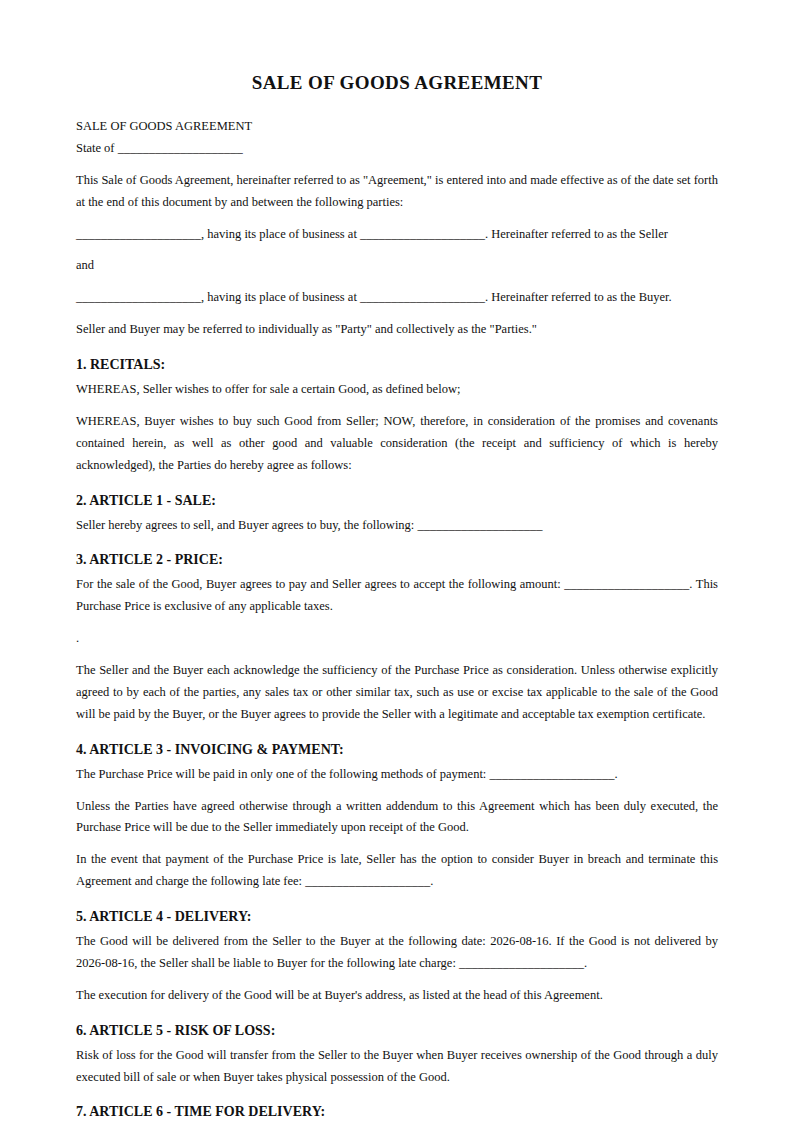
What a sale of goods agreement is
A sale of goods agreement records the sale of specific goods from a seller to a buyer.
It does what a purchase order and an invoice do between them, but as a single negotiated document, which suits a one off transaction of some value: a piece of equipment, a vehicle, a consignment of stock.
Sales of goods in Nigeria carry implied terms whether or not the parties write them down. Goods sold in the course of a business are expected to be of merchantable quality and reasonably fit for their purpose, and a seller is expected to have the right to sell them. Those protections exist under sale of goods law and the consumer protection framework, and a contract cannot simply write them away where the buyer is a consumer.
What the agreement adds is the specific commercial terms: what exactly is being sold, at what price, when it is paid for, when it arrives, and what happens if either side is late.
Who needs one
Businesses selling equipment, vehicles, machinery or a substantial consignment of stock.
Buyers of anything valuable enough that a receipt is not sufficient protection.
Parties dealing with each other for the first time, where a course of dealing has not yet built up.
Anybody paying a deposit, since a deposit paid without written terms is the most commonly lost money in commercial dealing.
For a repeat supply relationship, a purchase order against agreed standing terms is usually more practical than a fresh agreement for every order.
Before you start
Settle the commercial terms first.
Exactly what is being sold, identified specifically enough that no substitution is possible.
The price, and whether it includes VAT and delivery.
Whether a deposit is being paid, how much, and what happens to it if the sale does not complete.
When payment is due and by what method.
And when the goods will be delivered, and who is responsible if they are late.
The walkthrough
Filling in the form, step by step
Every question you will be asked, what it means, and an example of a good answer.
Step 1 of 3
Sale of Goods Agreement
The state, the seller and the buyer
The agreement opens by fixing the law and naming the parties.
The state governs the contract and determines where a dispute would be heard. Choose one connected to the transaction, normally where the goods are or where the seller trades, since enforcement means going to court somewhere real.
Name both parties properly. Where either is a business, use the registered name rather than a trading name, because that is the entity with the obligation and the one that could be sued.
This matters particularly on the seller's side. A buyer who discovers a defect and finds the seller was a trading name with no legal existence behind it has a recovery problem that better naming would have avoided.
- State
- The Nigerian state whose law governs the sale and where a dispute would be heard, for example Lagos State. Choose somewhere connected to the transaction, since enforcement means going to court there.
- Seller's Name
- The seller, using the registered name where it is a business. A trading name is not a legal entity, and a buyer with a defective product needs somebody real to pursue.
- Seller's Address
- The seller's address, which is where notices and any claim would be served.
- Buyer's Name
- The buyer, again using the registered name where a business is purchasing. This is the party liable for the price.
- Buyer's Address
- The buyer's address. Where the goods are being delivered somewhere else, note that separately, since this is the contractual address rather than the delivery point.
Step 2 of 3
Sale of Goods Agreement
The goods, the price and any deposit
This step defines what is being bought and what is being paid.
Identify the goods so precisely that substitution is impossible. Make, model, serial number, specification and quantity. For a vehicle, the chassis and engine numbers. For machinery, the serial number. A generic description lets a seller deliver something inferior and argue it matched the contract.
The price should state whether it includes VAT and whether it includes delivery, since both are common sources of disagreement after the fact.
The deposit question is the important one. Deposits are paid constantly in Nigerian commercial dealing and documented rarely, and the result is predictable: the sale falls through and the parties discover they never agreed whether the deposit was refundable. Say what it is for, and what happens to it if the buyer withdraws, if the seller fails to deliver, and if the sale simply does not proceed.
- Goods to be sold
- What is being sold, identified precisely: make, model, specification, quantity, and serial or chassis numbers where they exist. A generic description lets a seller deliver something lesser and argue it matched.
- Purchase Price
- The total price. State whether it includes VAT and whether it includes delivery, since both are assumed differently by each side and both surface after the goods arrive.
- Will there be a deposit?
- Choose Yes if any money is paid up front. Deposits are the most commonly lost money in Nigerian commercial dealing, almost always because nobody wrote down what happened to them.
- Deposit to be paid
- The amount and, crucially, the terms: what happens to it if the buyer withdraws, if the seller fails to deliver, and if the sale does not proceed for another reason. A deposit without written terms is a dispute waiting to happen.
Step 3 of 3
Sale of Goods Agreement
Payment, delivery and what happens if either is late
The closing step covers the mechanics and the consequences, and the two late fee questions are what make this agreement worth having.
Most sale agreements protect the seller against late payment and say nothing about late delivery. That asymmetry is worth noticing if you are the buyer. If the goods arriving on time matters to your business, a delivery date with no consequence attached is an aspiration rather than an obligation.
Both fees should be genuine estimates of the loss caused by lateness rather than punishments. A figure set to punish is open to challenge, which means it fails exactly when you want to rely on it.
On payment method, name one and be specific. Bank transfer to a stated account is verifiable. Cash creates a receipt problem for both sides, and a buyer paying cash without written acknowledgement has no evidence of payment at all.
- Payment Method
- How the price is paid, for example bank transfer to a stated account. Name the account and keep it consistent. Cash payments without written acknowledgement leave a buyer unable to prove they paid.
- Fee for late payment
- What the buyer pays if payment is late. Keep it a genuine estimate of the cost of the delay, since a figure set to punish is open to challenge at the moment the seller needs it.
- Date of Delivery
- When the goods will be delivered. Where the timing genuinely matters to the buyer, say so in the agreement, since a seller who knows a date is critical will tell you if they cannot meet it.
- Fee for late delivery
- What the seller pays if delivery is late. Buyers routinely leave this blank while accepting a late payment fee, which puts all the pressure on one side of a two sided obligation.
Ready to make yours?
Answer those questions in the builder and download a finished sale of goods agreement in Word and PDF.
Start now, ₦10,000After you download it
Inspect before you accept
Check the goods against the specification on delivery and record any defect immediately. Accepting goods without inspection weakens a later complaint considerably.
Keep proof of payment
Transfer receipts and written acknowledgements. A buyer who cannot prove payment is in a poor position however clearly the money left their account.
Know the implied terms
Goods sold in the course of business must be of merchantable quality and fit for purpose. Those protections exist whether or not the contract mentions them.
Say when title passes
The agreement should be clear about whether ownership transfers on payment or on delivery, because that determines who bears the loss if the goods are destroyed in between.
Questions people ask
What should a sale of goods agreement include?
The parties, a precise description of the goods, the price and what it includes, any deposit and its terms, the payment method and date, the delivery date, and the consequences of late payment or delivery.
Is my deposit refundable?
Whatever the agreement says, which is why it must say. Deposits paid without written terms are the most commonly lost money in Nigerian commercial dealing.
What if the goods are defective?
Goods sold in the course of a business must be of merchantable quality and reasonably fit for purpose. Those implied terms apply whether or not the contract mentions them, and consumer protection law reinforces them.
Can the seller exclude liability for defects?
Not against a consumer. Nigerian consumer protection law gives buyers rights to acceptable quality and a remedy for defective goods, and a contract term cannot write beneath that floor.
Should there be a late delivery fee?
If the timing matters to you as buyer, yes. Most agreements protect the seller against late payment and say nothing about late delivery, which leaves the obligation running one way.
When does ownership of the goods pass?
It depends on what the agreement says and on the nature of the goods. Make it explicit, because it determines who bears the loss if the goods are destroyed between sale and delivery.
Documents that go with this
Terms used on this page
Sale of Goods
A sale of goods is a contract to transfer ownership of moveable property for a price. Nigerian law implies terms about title, description and quality that a seller cannot always contract out of.
Consumer Protection
Consumer protection law gives buyers rights against sellers: honest information, safe goods, and redress when something is wrong. In Nigeria it is enforced by the FCCPC.
Warranty
A warranty is a promise in a contract that something is true. If it turns out not to be, the other side can claim damages, though usually not walk away from the deal.
Deposit
A deposit is money paid to secure a transaction. Whether you get it back if the deal falls through depends on whether it was a true deposit or a part payment, and most people never ask.
Incoterms
Incoterms are three letter trade rules that decide who arranges transport, who pays, and where risk passes from seller to buyer. They do not decide who owns the goods.
Product Liability
Product liability is responsibility for harm caused by a defective product. In Nigeria it can reach the manufacturer, the importer, the distributor and the retailer.
Ownership
Ownership is the greatest interest a person can hold in property. For Nigerian land it is qualified, because the Land Use Act vests land in the state and what you actually hold is a right of occupancy.
Breach of Contract
A breach of contract happens when one side fails to do what the agreement says they would do. The other side can then claim damages, and in serious cases walk away from the contract entirely.
Read more on this
Importance and Benefits of a Purchase Order
Importance and Benefits of a Purchase Order: Serious Businesses Use It — You Should Too In the early stages of running a business, many entrepreneurs rely on informal arrangements when buying goods or services. A quick p…
What Should I Write in My Terms and Conditions? Guide and Template
What Should I Write in My Terms and Conditions Most people see terms and conditions as a long legal document sitting at the bottom of a website. Many users click “agree” without reading it. Yet behind that simple checkbo…
How to Terminate a Contract the Right Way
How to Terminate a Contract the Right Way How do you end a contract properly without creating bigger problems? Because terminating a contract is not just about walking away. If done carelessly, it can expose you to claim…
Step by step guides for every document on LegalDoc
Browse all guides