
How to Write a Vehicle Lease Agreement
Leasing a vehicle rather than selling it keeps ownership with the lessor. Record the condition and the odometer, because both are disputed at the end.
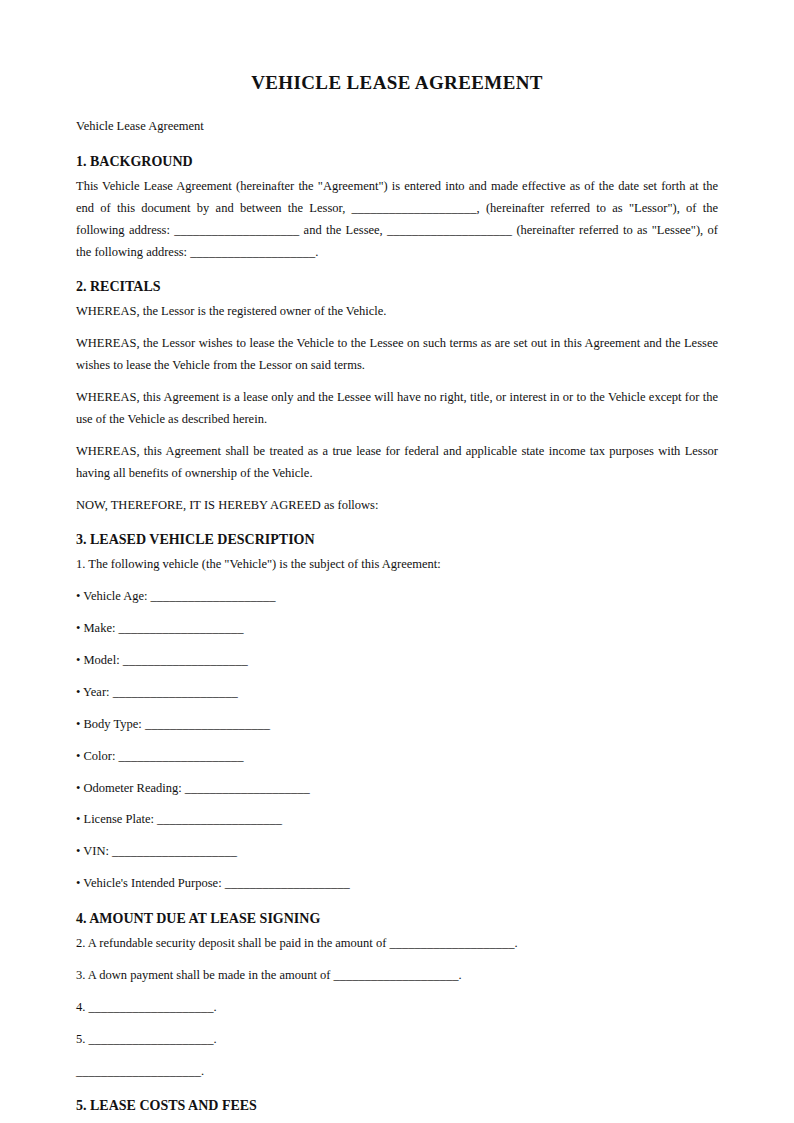
What a vehicle lease agreement is
A vehicle lease lets somebody use a car, van or truck they do not own, for a period, in exchange for payments.
Ownership stays with the lessor throughout. That is the defining feature and the reason the document matters: the lessee has possession and use, and the lessor retains title, which is what allows them to recover the vehicle if payments stop.
It is worth distinguishing this from hire purchase, which is common in Nigeria and works differently. Under hire purchase the hirer pays instalments and ownership transfers automatically once the final payment is made. Under a lease, ownership does not transfer at all unless there is a separate option to purchase, which this form asks about.
The practical risk in a vehicle lease is condition. A car returned after two years is not the car that went out, and the argument about what is fair wear and what is damage is settled entirely by what was recorded at the start.
Who needs one
Businesses leasing vehicles to staff or to customers.
Car owners renting a vehicle to somebody for an extended period rather than by the day.
Fleet operators and logistics businesses.
Anybody entering a long informal arrangement where a car has effectively been handed over with no documentation.
Where the intention is that the person keeps the vehicle at the end, hire purchase or a sale with instalments is the more honest structure, since a lease with an option to purchase and a hire purchase agreement have different legal characters.
Before you start
Do these before handing over the keys.
Photograph the vehicle thoroughly, inside and out, and record the odometer.
Confirm the insurance position, since a vehicle used by somebody other than the owner may not be covered by an ordinary policy.
Check the vehicle papers are current: licence, roadworthiness certificate and proof of ownership.
Decide who pays for servicing, repairs and tyres.
And establish what the vehicle may be used for, since commercial use and ride hailing change both the wear and the insurance position.
The walkthrough
Filling in the form, step by step
Every question you will be asked, what it means, and an example of a good answer.
Step 1 of 4
Vehicle Lease Agreement
The lessor and the lessee
The agreement names the owner and the user.
The lessor must actually own the vehicle or have authority to lease it. A lessee should ask to see the proof of ownership and compare the name against the person they are dealing with, for the same reason a buyer would.
Where the vehicle is subject to finance or has been used as security, leasing it out may breach that arrangement, and the lessor should check before granting.
Name the lessee as the party responsible for the payments and the vehicle. Where a business is leasing for a staff member, the business should be the lessee, since it is the entity that will pay and the one the lessor can pursue.
- Lessor's Name
- The owner of the vehicle. Where it is subject to finance or has been used as security, check whether leasing it out breaches that arrangement before granting.
- Lessor's Address
- The owner's address for payments and notices, and where the vehicle would be returned at the end of the term.
- Lessee's Name
- The party taking the vehicle. Where a business is leasing for a staff member, name the business, since it is the entity paying and the one the lessor can pursue if payments stop.
- Lessee's Address
- The lessee's address, which is also where the vehicle will normally be kept. It matters if the lessor ever needs to locate it.
Step 2 of 4
Vehicle Lease Agreement
The vehicle and its condition
This step identifies the vehicle and records its state, and it is the most important step in the document.
The condition entry is what settles the argument at the end. Record it honestly and in detail: existing scratches, dents, worn tyres, interior marks, anything not working. A lessor who records a vehicle as being in good condition has given away the ability to claim for damage that was already there, and a lessee who accepts that description has accepted responsibility for it.
Do it with photographs as well as words, taken on the day of handover, timestamped, and held by both parties. This single step prevents more vehicle lease disputes than everything else combined.
The chassis or vehicle identification number is what identifies this specific vehicle. Copy it from the car and check it against the papers, since a mismatch signals a problem with the vehicle's history.
The odometer reading at the start is what any mileage limit is measured against. Record the unit, since Nigerian vehicles are commonly in kilometres.
The purpose matters commercially and for insurance. A vehicle leased for private use and then used for ride hailing has considerably higher wear, and the insurance may not respond to a claim arising from a use the policy never covered.
- What is the current state of the vehicle been leased?
- The condition at handover, recorded honestly and in detail: existing scratches, dents, worn tyres, interior marks and anything not working. Photograph it too, timestamped, with both parties holding copies. This entry settles more end of lease disputes than anything else in the document.
- The make of the Vehicle?
- The manufacturer, taken from the vehicle papers rather than the badge, since imported vehicles occasionally differ between the two.
- Model of the Vehicle?
- The model as recorded in the papers, including the variant where given.
- Year of Manufacture?
- The year of manufacture from the papers, which on an imported vehicle is often not the year it was first registered here. Take the figure from the document rather than assuming.
- Body type of the Vehicle?
- The body type, for example saloon or sport utility, as one of the identifying details.
- Color/ colour of the Vehicle
- The colour as recorded in the papers rather than as you would describe it, since a discrepancy creates a query later.
- The odometer reading of the vehicle?
- The reading at handover, with the unit stated since Nigerian vehicles are commonly in kilometres. Any mileage limit is measured from here, so it needs to be accurate and agreed.
- Plate number of the vehicle?
- The registration number. Note that plates can be changed, which is why the identification number below is the more reliable identifier.
- Vehicle identification number (VIN) of the vehicle?
- The chassis or vehicle identification number, copied from the vehicle and checked against the papers. It identifies this specific car, and a mismatch between the two signals a problem with its history.
- The purpose for which the vehicle is been leased for?
- What the vehicle may be used for. It matters for wear and for insurance: a car leased for private use and then used for ride hailing carries far more wear, and a policy may not respond to a claim from a use it never covered.
Step 3 of 4
Vehicle Lease Agreement
Deposit, down payment, registration and insurance
This step allocates the upfront money and the running costs.
The refundable deposit covers damage and unpaid instalments. State what it may be applied to and when the balance is returned, since deposits are the second most disputed part of a vehicle lease after condition.
The down payment is different: it is usually not refundable and it reduces the total payable. Lessees should be clear which of the two they are paying, because the words are used loosely and the difference is the whole amount.
Registration and licensing costs recur annually in Nigeria, and vehicle papers must be kept current. Say who renews them. A lessee driving on an expired licence is exposed to enforcement, and a lessor whose vehicle is impounded because the lessee did not renew has a problem of their own.
Insurance is the one to get right. A vehicle driven by somebody other than the owner may not be covered under an ordinary policy, and an uninsured vehicle in an accident exposes both parties. Whoever arranges it, the cover should reflect the actual use, and the other party should see the certificate and each renewal.
- The amount for the refundable security deposit to be paid by the lessee?
- The refundable sum held against damage and unpaid instalments. State what it may be applied to and when the balance returns, since deposits are the second most disputed part of a vehicle lease after condition.
- The amount of down payment the lessee is required to pay?
- The initial payment, which is usually not refundable and reduces the total payable. Lessees should be clear which of the two they are paying, since the words are used loosely and the difference is the entire amount.
- Is there a requirement for payment of registration and license fee?
- Whether registration and licensing costs are payable during the term. These recur annually in Nigeria, so a lease of any length will encounter them.
- Who pays for the registration and license fee?
- Who renews the vehicle papers and pays for it. A lessee driving on an expired licence is exposed to enforcement, and a lessor whose vehicle is impounded because nobody renewed has a problem of their own.
- Will the lessee pay the lessor for Insurance coverage?
- Whether the lessee contributes to insurance. Whoever arranges cover, it must reflect the actual use, since a policy for private use may not respond to a claim from commercial driving.
- The amount to be paid by the lessee for Insurance?
- What the lessee pays towards cover. The party not arranging the policy should see the certificate at the outset and on each renewal, because lapsed cover is discovered after an accident.
- Do you want a provision for trade-in allowance, rebates, discount?
- Whether any allowance, rebate or discount applies. Common where a lessee is trading in another vehicle or where a fleet arrangement carries volume terms.
- Provision for trade-in, rebates discount and incentives
- Describe the arrangement: what is being traded in and at what value, or how the discount is calculated and when it applies. Vague incentive terms are argued about at the end of the term.
Step 4 of 4
Vehicle Lease Agreement
Value, payments and the option to purchase
The final step sets the payment schedule and what happens at the end.
The retail value matters for two reasons: it establishes what the lessor is putting at risk, and it is the reference point for any purchase option. A lessee should check it is realistic, since an inflated stated value makes an end of term purchase price look like a bargain when it is not.
Set the payment frequency to match how the lessee earns. A commercial operator earning daily may prefer weekly; a salaried lessee will manage monthly more reliably.
The option to purchase is where the document changes character. With an option, the lessee can acquire the vehicle at the end, and the agreement should state the price or the formula for calculating it. Without a stated price, an option is an agreement to negotiate rather than a right to buy.
Be aware of the distinction from hire purchase. Under hire purchase, ownership passes automatically on the final payment. Under a lease with an option, the lessee must exercise the option and pay the stated sum. If the parties intend the lessee to own the vehicle at the end, hire purchase is the more honest structure.
- The retail value of the vehicle?
- What the vehicle is worth. It establishes what the lessor is risking and is the reference for any purchase option. A lessee should check it is realistic, since an inflated value makes an end of term purchase price look better than it is.
- How often will the lessee make payment on the lease to the lessor?
- The payment frequency. Match it to how the lessee earns: a commercial operator taking daily receipts may manage weekly, while a salaried lessee will meet monthly more reliably.
- Weekly
- If weekly, state the day payment is due. Weekly suits commercial users with daily income and requires more administration from the lessor.
- Monthly
- If monthly, state the day of the month. Align it with the lessee's payday where you can, since payments due from an empty account are the usual cause of arrears.
- State the period here
- If another interval, describe it, including when each payment falls due and how many there are in total.
- The amount for each lease payment?
- The amount of each payment. State whether it includes anything else, such as maintenance or insurance, since assumptions about what the payment covers differ between the parties.
- On what day shall payment be made?
- The specific day each payment falls due. Naming a day closes off the vagueness that turns an ordinary late payment into a disagreement.
- Form of payment?
- How payment is made, for example bank transfer to a named account. Require transfers rather than cash, since a lessee claiming to have paid in cash is difficult to contradict.
- Fee to be paid incase of late payment?
- What is charged for late payment. Keep it a genuine reflection of the cost of the delay rather than a penalty, since a punitive figure is open to challenge.
- Is there an option for the lessee to purchase the vehicle at the end of the lease?
- Whether the lessee may buy the vehicle at the end. Note the difference from hire purchase: under hire purchase ownership passes automatically on the final payment, whereas an option must be exercised and paid for.
- option for purchase.
- If there is an option, state the purchase price or the formula for calculating it, and by when the option must be exercised. An option with no stated price is an agreement to negotiate rather than a right to buy.
- In which state is the vehicle been leased?
- The Nigerian state whose law governs and where the vehicle is principally kept. It is also where a claim to recover the vehicle or unpaid instalments would be brought.
Ready to make yours?
Answer those questions in the builder and download a finished vehicle lease agreement in Word and PDF.
Start now, ₦10,000After you download it
Photograph the vehicle at handover
Inside and out, timestamped, with the odometer visible, and both parties holding copies. This prevents more end of lease disputes than any clause in the document.
Confirm the insurance covers the actual use
A policy written for private use may not respond to a claim arising from commercial driving. Check the certificate rather than assuming.
Keep the vehicle papers current
Licensing and roadworthiness renew annually in Nigeria. Agree who does it, because an impounded vehicle is a problem for both parties.
Inspect together at the end
Compare the vehicle against the condition recorded at the start, with both parties present. Deposits are settled far more easily that way than by correspondence afterwards.
Questions people ask
What is the difference between a vehicle lease and hire purchase?
Under hire purchase, ownership passes automatically once the final instalment is paid. Under a lease, ownership stays with the lessor unless a separate purchase option is exercised and paid for.
Who insures a leased vehicle?
Whoever the agreement says, and the cover must reflect the actual use. A policy written for private use may not respond to a claim arising from commercial or ride hailing driving.
Why does the condition record matter so much?
Because it is what settles the argument at the end. A vehicle described simply as being in good condition leaves the lessor unable to claim for pre existing damage and the lessee responsible for it.
What is the difference between a deposit and a down payment?
A deposit is refundable and held against damage or arrears. A down payment is usually not refundable and reduces the total payable. The words are used loosely and the difference is the whole amount.
Who renews the vehicle licence?
Whoever the agreement says. Licensing and roadworthiness renew annually in Nigeria, and a lessee driving on expired papers exposes both parties.
Can the lessee buy the vehicle at the end?
Only if the agreement gives an option, and it should state the price or the formula. An option with no price is an agreement to negotiate rather than a right to buy.
Documents that go with this
Terms used on this page
Hire Purchase
Hire purchase is buying something by instalments while the seller keeps ownership until the final payment. You are hiring the item until the last instalment clears, then it becomes yours.
Lease
A lease is a grant of exclusive possession of property for a fixed term, in exchange for rent. It creates an interest in the land itself, which is what separates it from a mere permission to occupy.
Repossession
Repossession is a creditor taking back goods when payments stop. In Nigeria it must follow the contract and the law, and seizing a vehicle from the roadside is not how it is done.
Insurance
Insurance is paying a premium so somebody else carries a risk you cannot afford to carry yourself. It is a contract of utmost good faith, which means what you did not disclose matters as much as what you did.
Deposit
A deposit is money paid to secure a transaction. Whether you get it back if the deal falls through depends on whether it was a true deposit or a part payment, and most people never ask.
Ownership
Ownership is the greatest interest a person can hold in property. For Nigerian land it is qualified, because the Land Use Act vests land in the state and what you actually hold is a right of occupancy.
Detinue
Detinue is the claim you bring when somebody is holding your property and will not give it back. You must demand its return first, and the refusal is what creates the claim.
Subrogation
Subrogation lets an insurer that has paid a claim step into your shoes and sue whoever caused the loss. Settle privately with them first and you can lose your cover.
Read more on this
Why Every Loan Should Have a Proper Loan Agreement
Protecting the Lender and the Capital: Why Every Loan Should Have a Proper Loan Agreement Lending money to a friend, a business partner, or a small enterprise often begins with trust. In Nigeria, informal lending arrange…
How to Write a Demand Letter That Actually Gets You Paid (With a Template)
Importance and Benefits of a Purchase Order
Importance and Benefits of a Purchase Order: Serious Businesses Use It — You Should Too In the early stages of running a business, many entrepreneurs rely on informal arrangements when buying goods or services. A quick p…
Step by step guides for every document on LegalDoc
Browse all guides