
How to Write a Notice of Termination of Contract
Ending a contract badly turns your exit into their claim. The clause you rely on, and the notice you give, decide which one this is.
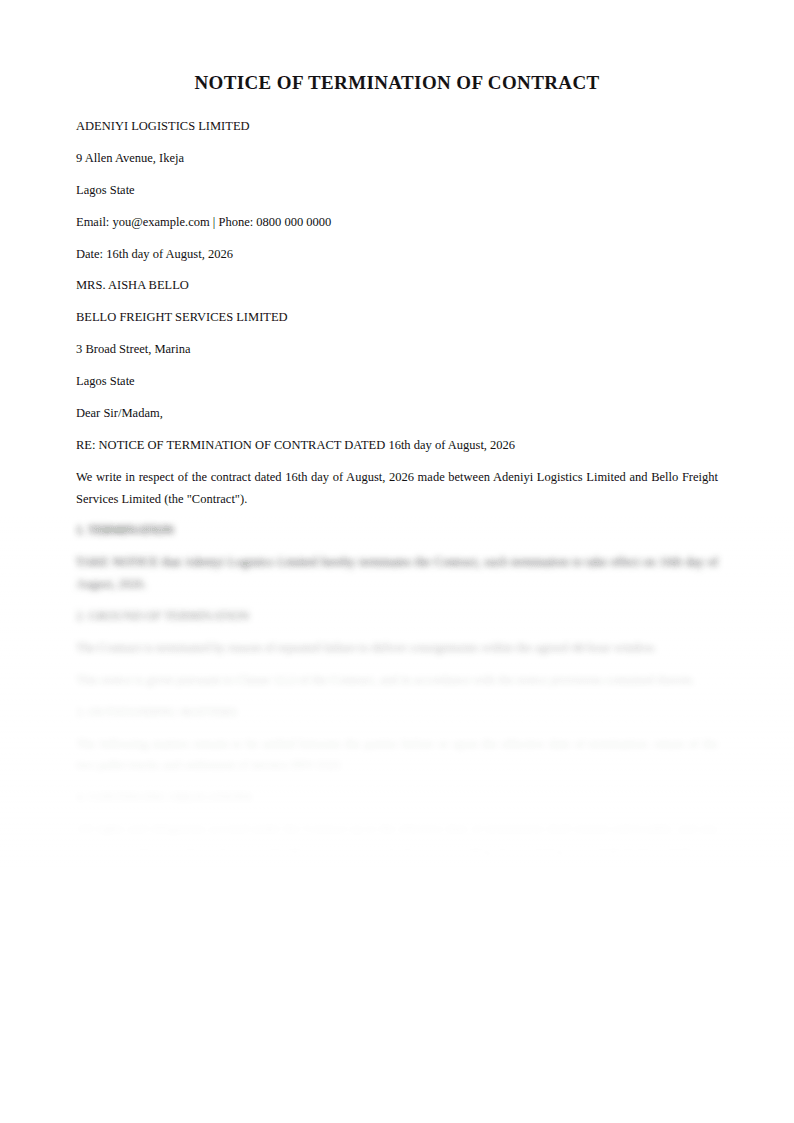
What a notice of termination of contract is
A notice of termination of contract is the formal written statement that you are bringing an agreement to an end.
How you end a contract matters as much as whether you were entitled to. Terminate correctly and the relationship ends on your terms. Terminate wrongly and you have committed a repudiatory breach, at which point the other side can accept your termination as a breach and claim damages against you.
That is the risk this document exists to manage. The notice should identify the contract, state the basis on which you are ending it, and give whatever notice the contract requires.
It is worth being clear about a distinction that causes confusion. Termination for convenience is ending a contract because the agreement lets you, usually on notice, without needing a reason. Termination for cause is ending it because the other side breached. They have different requirements, and using the wrong one is how a lawful exit becomes an unlawful one.
Who needs one
Businesses ending a supplier, service or distribution arrangement that is no longer working.
Clients terminating a contractor or consultant.
Anybody wanting to exit a contract before its natural end, whether because of poor performance or a change in circumstances.
Parties whose contract has a notice period they need to trigger formally, since informal notice frequently does not satisfy the clause.
For employment, the position is different and more protective of the employee, and a termination of employment should follow the employment contract and the Labour Act rather than this commercial notice.
Before you start
Read the contract before you write anything, because everything depends on it.
Find the termination clause and read exactly what it permits, on what notice, and in what form.
Check how notice must be given: some contracts require writing to a specified address, and email may not satisfy them.
Establish whether you are terminating for convenience or for breach, since the requirements differ.
Work out what you owe and what is owed to you.
And identify what survives termination, since confidentiality, indemnities and dispute resolution clauses usually continue.
The walkthrough
Filling in the form, step by step
Every question you will be asked, what it means, and an example of a good answer.
Step 1 of 3
Notice of Termination of Contract
Who you are
The notice opens by identifying the party giving it.
Name the contracting entity rather than yourself personally, where a company holds the contract. A notice given by somebody who is not a party to the agreement is open to the objection that it was not validly given, which is an unhelpful argument to have when you thought the contract had ended months ago.
The address and state matter for service. Many contracts specify where notices must be sent and by what method, and a notice sent to the wrong address or by the wrong means may simply not count.
Give contact details. Termination often leads to a conversation about winding down, returning equipment and settling accounts, and that conversation is cheaper than the alternative.
- Your name
- Your name as the person giving notice on behalf of the contracting party. Where a company holds the contract, you are signing for the company named below.
- Your company name
- The registered name of the entity that is a party to the contract. A notice given by somebody who is not a party can be challenged as invalid, which is a poor discovery to make later.
- Your address
- Your address for correspondence about the termination and anything arising from it.
- Your state
- Your state, which forms part of the address and may be relevant to where a dispute would be heard.
- Your email
- An email address you monitor. Termination usually starts a conversation about handover and final accounts, and that conversation is far cheaper than the alternative.
- Your phone number
- A contact number. Practical questions arise immediately after a termination notice, and being reachable resolves most of them.
- Date of this notice
- The date of the notice. Notice periods are counted from receipt, so send it on the day you date it and keep evidence of delivery.
Step 2 of 3
Notice of Termination of Contract
Who you are ending the contract with
This step names the other party and where the notice is going.
Use the entity named in the contract. Businesses restructure, rebrand and trade through different names, and a notice addressed to a company that is not the contracting party may not be effective.
The address is the important part here. Check the contract's notice clause: many specify an address for service, and some require notice to be sent to a particular officer or department. Sending it correctly is what makes it valid, and sending it to the person you usually deal with may not satisfy the clause even though they will certainly read it.
Where the contract permits email, use it and keep the delivery confirmation. Where it does not, use the prescribed method and treat email as a courtesy copy rather than as the notice itself.
- Their contact name
- Your usual contact at the other party. They will read it, though validity depends on the notice reaching the address the contract specifies rather than the person you normally deal with.
- Their company name
- The other party as named in the contract, using the registered name. Businesses rebrand and restructure, and a notice addressed to an entity that is not the contracting party may not be effective.
- Their address
- The address for service. Check the contract's notice clause, since many specify an address and a method, and a notice sent elsewhere may not count however clearly it was received.
- Their state
- Their state, completing the address for service.
Step 3 of 3
Notice of Termination of Contract
The contract, the date and the reason
This step does the actual work, and the clause reference is the part to get right.
Identify the contract by date so there is no doubt which agreement is ending, particularly where the parties have several.
The termination clause is optional on the form and important in practice. Citing the clause you are relying on demonstrates that you are exercising a contractual right rather than simply walking away. Where you are terminating for convenience under a notice provision, say so and give the required period. Where you are terminating for breach, cite the clause permitting it and state the breach.
The effective date must respect the notice period. This is where terminations go wrong: a contract requiring ninety days notice, terminated with thirty, is not an early termination but a breach, and the other side may treat it as one.
On the reason, be accurate and restrained. Where you are terminating for convenience you need no reason at all, and inventing a complaint about performance invites a dispute you did not need. Where you are terminating for breach, describe it factually with dates.
Outstanding matters is where you set the terms of the wind down: what is returned, what is paid, what is handed over.
- Date of the contract being terminated
- The date of the contract being terminated, so there is no doubt which agreement this concerns, particularly where the parties have entered several over time.
- Date the termination takes effect
- When the termination takes effect. It must respect the notice period the contract requires. Giving thirty days where the contract demands ninety is not an early exit, it is a breach the other side can act on.
- Which clause allows termination? (optional)
- The clause you are relying on, for example Clause 12.2. Optional on the form and worth including, since citing it shows you are exercising a contractual right rather than simply walking away from the agreement.
- Why are you terminating?
- Why you are terminating. Where the contract allows termination for convenience you need no reason, and inventing a performance complaint invites a dispute. Where you are terminating for breach, describe it factually with dates.
- What still needs to be settled? (optional)
- What still has to be settled: equipment returned, final invoices paid, data handed over, work in progress completed. Setting this out invites an orderly wind down rather than an argument about who owes what.
Ready to make yours?
Answer those questions in the builder and download a finished notice of termination of contract in Word and PDF.
Start now, ₦5,000After you download it
Serve it the way the contract requires
Check the notice clause for the address and method. A notice sent by a means the contract does not permit may be ineffective however clearly it was received.
Keep performing until the date
The contract continues until termination takes effect. Stopping work the moment you send the notice is itself a breach, whatever your entitlement to terminate.
Know what survives
Confidentiality, indemnities, intellectual property and dispute resolution clauses usually continue after termination. Ending the contract does not end those obligations.
Settle the accounts in writing
Agree what is owed both ways and record it. An unresolved final invoice is how a clean termination becomes a demand letter three months later.
Questions people ask
What is the difference between termination and dismissal?
Dismissal is an employment concept, where an employer ends a contract of employment, often for misconduct. Termination is the general contractual concept of bringing an agreement to an end, whether by notice or for breach.
What is termination for convenience?
Ending a contract because the agreement permits it, usually on stated notice, without needing a reason. It is different from terminating for breach, which requires the other side to have done something wrong.
What happens if I give short notice?
Terminating with less notice than the contract requires is generally a breach rather than an early exit. The other side may accept it as a repudiation and claim damages against you.
Do I have to give a reason for terminating?
Not where the contract allows termination for convenience. Inventing a performance complaint in that situation only creates a dispute you did not need to have.
Can I stop work as soon as I send the notice?
No. The contract continues until termination takes effect, and stopping performance early is itself a breach whatever your entitlement to terminate was.
What survives termination?
Usually confidentiality, indemnities, intellectual property provisions and dispute resolution clauses. Ending the contract does not end obligations expressed to continue after it.
Documents that go with this
Terms used on this page
Termination
Termination is the ending of a contract on its terms. In employment it means the relationship ends, normally with notice or payment in lieu, and it does not imply that anybody did anything wrong.
Termination for Convenience
Termination for convenience is a right to end a contract without anybody being in breach, simply on notice. Where a contract has one, it is usually the safest way out.
Breach of Contract
A breach of contract happens when one side fails to do what the agreement says they would do. The other side can then claim damages, and in serious cases walk away from the contract entirely.
Notice Period
A notice period is how much warning either side must give before ending an employment. The Labour Act sets minimums based on length of service, and the contract can give more but not less.
Damages
Damages are money a court awards to compensate you for a loss somebody else caused. The aim is to put you where you would have been if the wrong had never happened, not to punish the other side.
Force Majeure
Force majeure is a contract clause that excuses a party from performing when something outside their control makes it impossible. It only helps you if it is actually written into the contract.
Dispute Resolution Clause
A dispute resolution clause says what happens when the parties disagree: who decides, where, under what law, and what must be tried first. It is the clause nobody reads until it is the only one that matters.
Specific Performance
Specific performance is a court order compelling somebody to actually do what they promised, instead of paying damages for not doing it. Courts grant it sparingly, and mainly where money would not be an adequate remedy.
Read more on this
How to Terminate a Contract the Right Way
How to Terminate a Contract the Right Way How do you end a contract properly without creating bigger problems? Because terminating a contract is not just about walking away. If done carelessly, it can expose you to claim…
How to Write a Demand Letter That Actually Gets You Paid (With a Template)
Service Level Agreements: What Small Businesses Need to Avoid Disputes
Service Level Agreements: What Small Businesses Need to Avoid Disputes Running a small business in Nigeria often involves working with other businesses, vendors, consultants, freelancers, and service providers. A graphic…
Step by step guides for every document on LegalDoc
Browse all guides