
How to Respond to a Demand Letter
Ignoring a demand letter is the worst option available. A measured reply protects your position and often settles the matter at a fraction of the amount claimed.
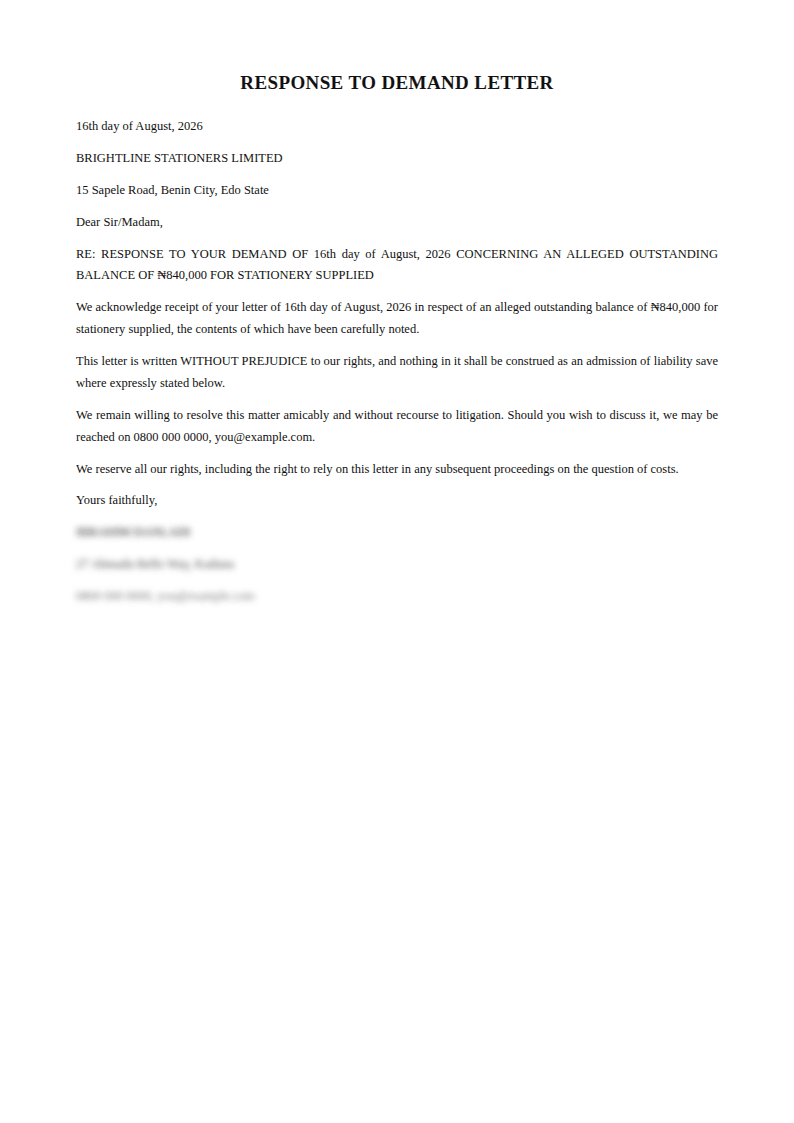
What a response to demand letter is
A response to a demand letter is your written reply to somebody claiming you owe them money or owe them performance.
It is the point at which you take control of the narrative. Silence lets the other side build a story in which you were asked repeatedly and never engaged, which is exactly the story they will tell a court.
A reply does the opposite. It sets out what you accept, what you dispute and why, and what you propose. Even where you accept the whole claim, a reply proposing terms is better than nothing, because it turns a demand into a negotiation.
One caution before writing: what you say here can be used later. An unqualified acknowledgement of a debt can restart the limitation period and remove a defence you had. Write carefully, and where the sum is significant, take advice before replying.
Who needs one
Anybody who has received a demand letter, whether they think it justified or not.
Businesses disputing an invoice, particularly where goods were short delivered or services were not performed as agreed.
People who accept part of a claim but not all of it, which is the most common real position.
Anybody who wants to settle but cannot pay in full immediately, since a proposal is far more likely to be accepted than silence followed by a court appearance.
Before you start
Do the groundwork before replying.
Read the demand carefully and identify precisely what is claimed and on what basis.
Check your own records: invoices, delivery notes, payments made, messages exchanged.
Work out what you genuinely accept and what you dispute, separating the two rather than rejecting everything.
Decide what outcome you actually want, and what you can realistically afford.
And note the deadline in the demand, since replying within it is itself evidence of good faith.
The walkthrough
Filling in the form, step by step
Every question you will be asked, what it means, and an example of a good answer.
Step 1 of 3
Response to Demand Letter
The parties and the dates
The reply opens by identifying both sides and, importantly, both dates.
Referencing the date of the demand letter you received is not a formality. It ties your reply to their specific letter, which matters where there has been correspondence over months and several letters are in play. It also demonstrates that you responded to what was actually sent rather than to a version of it.
Reply within their deadline where you can. A response sent inside the stated period, even one disputing everything, positions you as somebody engaging with the problem. A reply that arrives three weeks after the deadline, alongside a court process, looks very different.
Name the correct parties. If the demand was addressed to your company but the debt is genuinely personal, or the reverse, say so in the reply, because that may be the whole answer.
- Your name
- Your full name, or the name of the entity replying. Where the demand was wrongly addressed, for example to you personally about a company debt, this is the first thing to correct.
- Your address
- Your address for correspondence. Any further letters, and any court process, will be directed here, so use somewhere you reliably receive post.
- Who sent you the demand? (their name)
- Who sent the demand, using the name on their letter. Where a lawyer wrote on their client's behalf, address the reply as the letter directs.
- Their address
- Their address as given on the demand letter. Replying to the address they used avoids any suggestion that your response went astray.
- Date of your reply
- The date of your reply. Send it within the deadline in the demand where you can, since a prompt response is itself evidence that you engaged with the claim.
- Date on the demand letter you received
- The date on the letter you received. It ties your reply to their specific correspondence, which matters where several letters have passed between you over time.
Step 2 of 3
Response to Demand Letter
What they want and how you answer
This is the substance, and the four options exist because a real reply usually needs more than one of them.
Most genuine disputes are not total. You accept part of the claim, dispute another part, want documents for a third, and can propose a way forward. Ticking several boxes and completing each is more credible than a blanket denial, and it moves the matter towards resolution rather than entrenchment.
Be careful with the acknowledgement. Accepting that a sum is owed is useful for settling and it has consequences: it can restart the limitation period and it removes any argument that the debt never existed. Acknowledge what is genuinely owed, and say nothing beyond that.
When disputing, give reasons and evidence rather than assertions. Only part of the order was delivered, on 20 May, and the balance claimed does not reflect the shortfall is a defence. I do not accept the invoice is not.
A proposed resolution is what actually ends most of these disputes. Creditors accept structured payment far more readily than people expect, because certainty beats litigation.
Requesting information is legitimate where you genuinely cannot verify the claim, and it is a delaying tactic when used without cause. Ask for documents you actually need to assess what is owed.
- What are they demanding?
- What they are claiming, in your own words, for example an alleged outstanding balance for stationery supplied. Framing it as alleged where you dispute it keeps your position clear from the outset.
- How do you want to answer? (choose all that apply)
- Tick everything that applies, and most genuine replies need more than one. A response that accepts part, disputes part and proposes a way forward is far more credible than a blanket denial.
- What do you disagree with, and why?
- What you dispute and why, with the facts behind it: dates, quantities, what was actually delivered or performed. Reasons and evidence make a defence; a bare denial makes an argument.
- What do you accept? (if anything)
- What you accept, if anything. Be precise and go no further, because acknowledging a debt can restart the limitation period and removes any argument that it never existed.
- What are you proposing?
- What you are offering: a payment in full, instalments with dates, or performance of the obligation by a stated time. Creditors accept structured payment more readily than people expect, since certainty beats litigation.
- What do you need from them?
- Documents you genuinely need to assess the claim, such as signed delivery notes or a full statement of account. Ask for what you actually need, since a request made purely to delay is transparent.
Step 3 of 3
Response to Demand Letter
How they can reach you
The closing step gives them a route to respond, and it is worth completing properly.
A reply that disputes a claim and gives no contact details reads as a document written to be filed rather than to resolve anything. If you have proposed instalments, somebody needs to be able to accept them.
Give a number and an email you will monitor. The period immediately after a reply is when settlement happens, and a creditor who cannot reach you moves on to the next step by default.
Keep a copy of everything: your reply, proof of sending, and any response. If this does become a claim, the correspondence is the first thing a court sees, and a party who replied promptly, engaged with the detail and proposed a resolution is in a materially better position than one who did not.
- Your phone number and/or email
- A number and email you will monitor. The weeks after a reply are when most of these matters settle, and a creditor who cannot reach you to accept your proposal simply proceeds to the next step.
Ready to make yours?
Answer those questions in the builder and download a finished response to demand letter in Word and PDF.
Start now, ₦5,000After you download it
Send it before their deadline
A reply inside the stated period, even one disputing everything, shows engagement. One arriving weeks late alongside a court process does not.
Keep the whole correspondence
Your letter, proof of sending, and anything that comes back. If this becomes a claim, the correspondence is the first thing a court reads.
Honour any proposal you make
An offer of instalments that you then miss is worse than making no offer, because it removes the goodwill your reply earned.
Take advice on significant sums
What you write can be used against you, particularly an acknowledgement of debt. For anything substantial, have somebody check the reply before it goes.
Questions people ask
Should I respond to a demand letter?
Yes. Silence lets the other side tell a court you were asked repeatedly and never engaged. A measured reply protects your position and often settles the matter.
Can I admit part of the claim?
Yes, and it is often the honest and effective answer. Be precise about what you accept, because an acknowledgement of debt can restart the limitation period and removes the argument that nothing was owed.
What if I dispute the whole claim?
Say so with reasons and evidence, not just a denial. Dates, quantities and what was actually delivered make a defence; a bare rejection makes an argument.
Can I offer to pay in instalments?
Yes, and creditors accept structured payment more often than people expect, because certainty beats litigation. Propose specific amounts and dates rather than a general willingness to pay.
Can I ask for more information?
Where you genuinely cannot verify the claim, yes: signed delivery notes, a statement of account. A request made only to delay is transparent and damages your credibility.
Do I need a lawyer to reply?
Not for a modest sum, but what you write can be used later. For anything substantial, have the reply checked before sending, particularly if you are acknowledging any part of the debt.
Documents that go with this
Terms used on this page
Demand Letter
A demand letter is a formal written request for payment or action, sent before you take legal steps. In Nigeria it is usually the cheapest and fastest way to get somebody to take you seriously.
Set-Off
Set-off is deducting what somebody owes you from what you owe them. It is a genuine right in defined circumstances, and contracts frequently exclude it.
Counterclaim
A counterclaim is a claim brought by a defendant against the claimant in the same proceedings. It stands on its own, and it survives even if the original claim is withdrawn.
Limitation Period
A limitation period is the deadline for bringing a claim to court. Once it passes, the claim is statute barred, and it will be struck out however strong it was on the facts.
Breach of Contract
A breach of contract happens when one side fails to do what the agreement says they would do. The other side can then claim damages, and in serious cases walk away from the contract entirely.
Bad Debt
A bad debt is money owed that will not be collected. Writing it off is an accounting step, and claiming it as a tax deduction has conditions that must be satisfied.
Judgment
A judgment is the court's decision in a case. Winning one is not the same as being paid, because enforcement is a separate process that begins after the judgment is delivered.
Small Claims Court
A small claims court recovers modest debts quickly and cheaply, without needing a lawyer. Lagos runs one and several other states have followed, and most Nigerians have never heard of it.
Read more on this
How to Write a Demand Letter That Actually Gets You Paid (With a Template)
How to Terminate a Contract the Right Way
How to Terminate a Contract the Right Way How do you end a contract properly without creating bigger problems? Because terminating a contract is not just about walking away. If done carelessly, it can expose you to claim…
The Importance of a Dispute Resolution Clause in a Loan Agreement
The Importance of a Dispute Resolution Clause in a Loan Agreement One party needs funds. The other is willing to provide it. The terms are discussed, repayment is scheduled, and both sides expect everything to go accordi…
Step by step guides for every document on LegalDoc
Browse all guides