
How to Write a SAFE Agreement
A SAFE takes investment now and converts it to equity later, without setting a valuation today. It is a US instrument, and that matters for Nigerian founders.
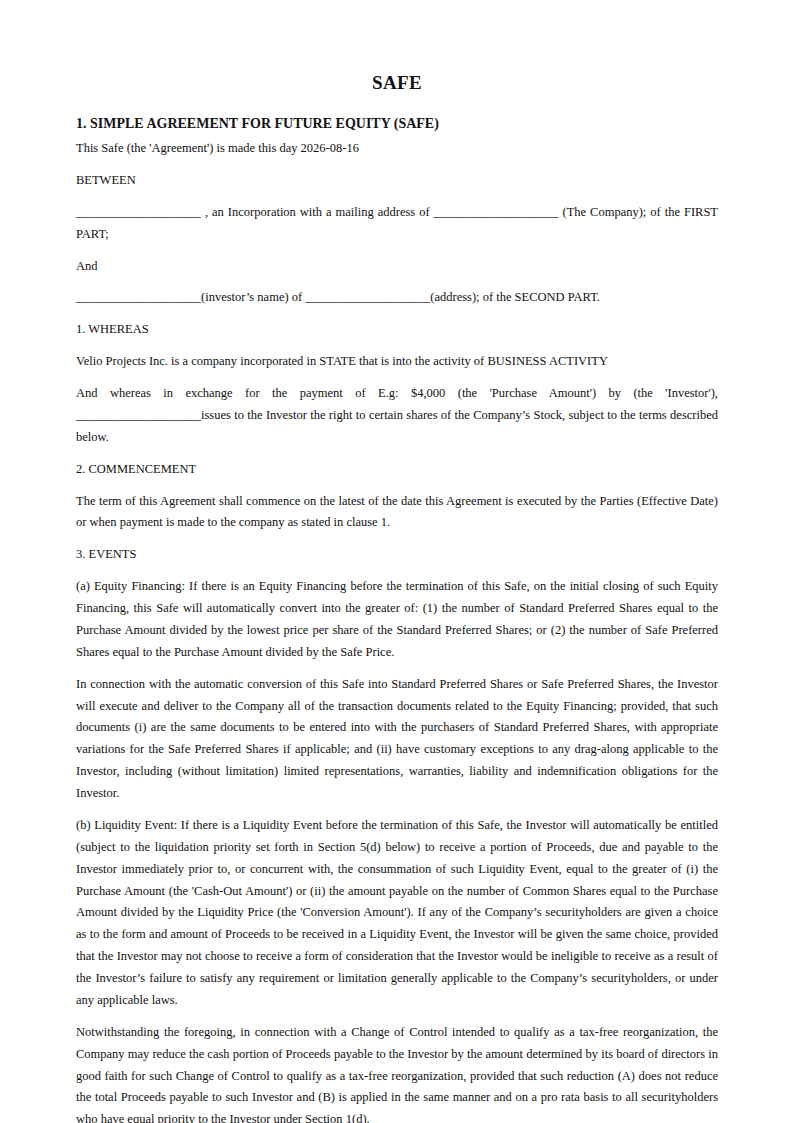
What a safe is
A SAFE is a Simple Agreement for Future Equity. An investor gives a startup money now, and instead of receiving shares immediately, receives the right to shares when a future priced funding round happens.
It exists to avoid the hardest question in early stage investing: what is this company worth today. Agreeing a valuation for a business with no revenue is difficult and often arbitrary, so a SAFE postpones it. The investor's money converts at the valuation set by the next proper round, usually with a discount or a valuation cap in their favour.
It is not a loan. There is no interest, no repayment date and no obligation to repay if nothing ever converts. The investor takes the risk that no priced round happens, in which case the SAFE may be worth nothing at all.
It originated in the United States, which is why this form asks for a US state.
Who needs one
Early stage startups raising a first cheque before they can sensibly be valued.
Angel investors backing founders at a point where a full priced round would be premature and expensive to paper.
Founders raising from US investors, who will expect this instrument and know its terms.
For a Nigerian company raising from Nigerian investors, take advice before using this. A SAFE is built around US corporate law concepts, and CAMA 2020 governs share issues in Nigeria differently. Nigerian rounds are often better documented as a convertible loan note or a straightforward share subscription.
Before you start
Understand the terms this form does not ask about, because they are the ones that determine what the investor eventually gets.
The valuation cap: the maximum valuation at which the investment converts, which protects the investor if the company does very well before the next round.
The discount rate: the reduction on the next round price the investor receives.
What triggers conversion, and what happens if the company is sold before any round.
Those belong in the SAFE and this short form does not prompt for them, so raise them with your investor and your adviser.
The walkthrough
Filling in the form, step by step
Every question you will be asked, what it means, and an example of a good answer.
Step 1 of 4
SAFE
The date and the governing state
The SAFE opens with the date and the state whose law governs it.
The state list here is American, which tells you what this instrument is. Delaware is the usual answer for a startup incorporated there, and the choice should follow where the company is actually incorporated rather than being picked at random.
For a Nigerian founder this is the moment to be clear about structure. A SAFE issued by a Nigerian company under Delaware law is an awkward hybrid: the conversion mechanics assume a US corporation with authorised but unissued stock, while a Nigerian company operates under CAMA rules on allotment and pre-emption. If the investment is genuinely into a Nigerian entity, take advice on whether a convertible note under Nigerian law would serve you better.
Where the company already has a US parent, this is straightforward and the state should be the parent's state of incorporation.
- What is the date of the sale?
- The date the SAFE is signed and the investment is made. It matters because rights under a SAFE rank by date where a company issues several, and investors care about their position relative to others.
- State
- The US state whose law governs the instrument, which should follow where the company is incorporated. Delaware is the common answer. If the company is Nigerian rather than American, take advice before proceeding, since the conversion mechanics assume US corporate law.
Step 2 of 4
SAFE
The company receiving the investment
This step names the company issuing the SAFE.
Name the entity that will actually issue shares on conversion. For a startup with a US parent and a Nigerian operating subsidiary, the SAFE is normally issued by the parent, since that is where investors want their equity and where the conversion mechanics work.
Getting this wrong is not a technicality. An investor who paid a Nigerian subsidiary but expected shares in the US parent has a problem that becomes apparent at exactly the wrong moment, usually when the next round's lawyers examine the cap table.
Use the registered address of that entity rather than wherever the team happens to sit.
- Company's name
- The registered name of the company issuing the SAFE, which must be the entity that will actually issue shares on conversion. In a group with a US parent and a Nigerian subsidiary, this is normally the parent.
- Company's address
- The registered address of that entity. Use the address on its incorporation record rather than the operating address, since this identifies the legal person taking the money.
Step 3 of 4
SAFE
The investor
This step names who is putting in the money and will receive shares later.
Name them as they should appear on the cap table, because that is where this ends up. Investors frequently invest through a company, a fund or a family vehicle rather than personally, and the entity named here is the one that gets the shares.
The address is where notices go, including the notice that a priced round is happening and their SAFE is converting. Investors move and companies forget to update records, and an investor who missed a conversion notice because it went to a stale address is an avoidable problem.
Where several investors are participating on the same terms, each signs a separate SAFE rather than one document with several names.
- Investor's name
- The investor as they should appear on the cap table. Many invest through a company, fund or family vehicle rather than personally, and whichever entity is named here is the one that receives shares on conversion.
- Investor's address
- The investor's address for notices, including notice that a priced round is triggering conversion. Keep it current, since an investor who missed a conversion notice is an entirely avoidable dispute.
Step 4 of 4
SAFE
The amount invested
The final question is the money.
State the amount and be explicit about the currency. The form's example uses dollars, and for a Nigerian company taking foreign investment the currency question is not cosmetic: it determines what converts, and exchange movement between investment and conversion can be substantial.
If foreign currency is coming into Nigeria as investment, remember the certificate of capital importation. Foreign capital should enter through an authorised dealer bank, which issues the certificate, and without it repatriating dividends or exit proceeds through official channels becomes very difficult later. That applies to the eventual equity even though the SAFE itself is not yet shares, so raise it with the bank at the point the money arrives rather than years afterwards.
And remember what this form has not captured: the valuation cap and the discount rate. Those decide how much equity the investor eventually receives, and a SAFE without them is incomplete.
- Amount to be invested
- The investment amount, with the currency stated explicitly. Where foreign currency is entering Nigeria, bring it in through an authorised dealer bank and obtain the certificate of capital importation, since repatriating proceeds later without one is very difficult.
Ready to make yours?
Answer those questions in the builder and download a finished safe in Word and PDF.
Start now, ₦10,000After you download it
Add the cap and the discount
This short form does not ask for them, and they determine what the investor eventually gets. A SAFE without a valuation cap or discount is not a complete instrument.
Track it on the cap table
SAFEs are invisible until they convert, and founders routinely underestimate the dilution waiting for them. Model the conversion before raising the next round, not during it.
Document the money coming in
Foreign investment into Nigeria should enter through an authorised dealer bank with a certificate of capital importation, which is what makes later repatriation possible.
Take advice on the structure
If the investment is into a Nigerian company rather than a US parent, a convertible note under Nigerian law may fit better than an instrument built for US corporate mechanics.
Questions people ask
What is a SAFE agreement?
A Simple Agreement for Future Equity. An investor gives money now and receives shares later, when a priced funding round sets a valuation, usually with a discount or valuation cap in their favour.
Is a SAFE a loan?
No. There is no interest, no repayment date and no obligation to repay. The investor accepts the risk that no priced round ever happens, in which case the SAFE may be worth nothing.
Can a Nigerian company issue a SAFE?
Take advice first. A SAFE is built around US corporate law, while CAMA 2020 governs Nigerian share allotments differently. A convertible note under Nigerian law is often the better fit.
What is a valuation cap?
The maximum valuation at which the investment converts, protecting the investor if the company grows substantially before the next round. This short form does not ask for it, so add it.
What is the discount rate?
The reduction on the next round's share price that the SAFE investor receives, rewarding them for investing earlier and at greater risk.
Do I need a certificate of capital importation?
If foreign currency is entering Nigeria as investment, yes. Bring it through an authorised dealer bank, because repatriating dividends or exit proceeds through official channels without one is very difficult.
Documents that go with this
Terms used on this page
Convertible Note
A convertible note is a loan that turns into shares at the next funding round, usually at a discount. It lets an investor put money in now without agreeing a valuation today.
Valuation
A valuation is a professional opinion of what something is worth. It is needed for probate, lending, tax, disputes and investment, and the method used changes the number considerably.
Share Capital
Share capital is the value of shares a company has issued or is permitted to issue. It is not cash in the bank, and the figure you declare at the CAC drives your registration cost.
Certificate of Capital Importation
A certificate of capital importation evidences foreign capital brought into Nigeria through an authorised bank. Without one, taking dividends or sale proceeds back out through official channels is very difficult.
Vesting
Vesting is equity earned over time rather than given all at once. It is how startups make sure a founder or employee who leaves in year one does not keep a share meant to reward years of work.
Anti-Dilution
Anti-dilution protects an investor if the company later raises money at a lower price. It adjusts their position so they are not left holding shares bought at a price nobody would pay now.
Due Diligence
Due diligence is the investigation you carry out before committing to a deal. You are checking that what you are buying, funding or partnering with is actually what it was described to be.
Shareholders Agreement
A shareholders agreement is the private contract between the owners of a company covering how it is run, how shares move and what happens when they disagree. The articles do not do that job.
Read more on this
10 Legal Documents Every Startup in Nigeria Needs
10 Legal Documents Every Startup in Nigeria Needs Starting a business in Nigeria is exciting. Entrepreneurs launch new ventures every day—technology startups, creative agencies, e-commerce platforms, consulting firms, an…
Founders Vs. Shareholders
When building a company, it’s important to understand the distinct roles of founders and shareholders and the legal documents that formalize their relationships. Founders: Globally, roughly 40 million startup companies a…
11 Essential and Protective Documents Needed by a Startup Company
Business Plan Certificate of Incorporation, Memart, Art. of association, Status Report Founders’ Agreement Service Level Agreements Non-Disclosure Agreement Employee Contracts Intellectual Property Agreements Shareholder…
Step by step guides for every document on LegalDoc
Browse all guides