
How to Write a Service Level Agreement
An SLA turns a vague promise of good service into a measurable standard with a consequence attached. Without the measurement, it is just a services contract.
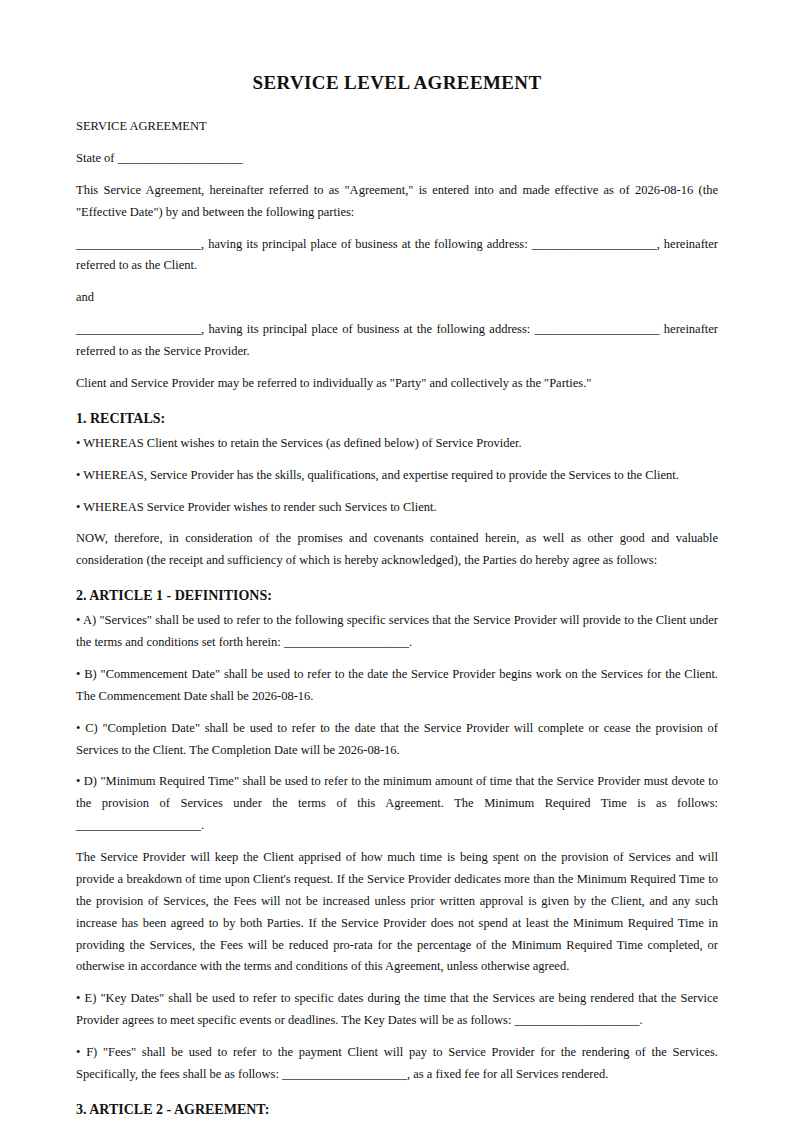
What a service level agreement is
A service level agreement sets out not just what service will be provided, but to what standard, measured how, and what happens if the standard is not met.
That last part is what separates it from an ordinary services contract. Anybody can promise good service. An SLA says the response time will be four hours, uptime will be ninety nine per cent, and here is the credit if it is not.
The measurement is the point. A commitment nobody can measure is a commitment nobody can breach, and an SLA full of language about best efforts and reasonable standards is a services contract wearing a different name.
For a client, an SLA is what makes a supplier accountable. For a supplier, a well drafted one is protection too, because it defines the ceiling of what was promised and prevents a client expanding expectations after the fact.
Who needs one
Businesses buying services where reliability matters: IT support, hosting, facilities management, logistics, security, cleaning.
Service providers who want their obligations defined rather than assumed, particularly where a client has been quietly expanding what they expect.
Anybody in an ongoing supplier relationship that has gone wrong once and needs a clearer footing.
Where the engagement is a one off project with a deliverable rather than an ongoing service, a consulting or contractor agreement is usually the better fit.
Before you start
Work out what you can actually measure.
The specific services, listed rather than described in general terms.
The standard for each: response time, resolution time, availability, frequency.
How performance will be measured and who reports it.
What happens when the standard is missed, whether a credit, a reduction or an escalation.
And how much of that provider time the client is entitled to, since that is what stops a service becoming whatever the provider has spare.
The walkthrough
Filling in the form, step by step
Every question you will be asked, what it means, and an example of a good answer.
Step 1 of 3
Service Level Agreement
The date, the jurisdiction and the client
The agreement opens by naming the client and, unusually, asking what kind of legal entity they are.
That question is worth answering accurately because it determines who is liable and how the agreement is signed. An individual signs personally and is personally liable. A limited company signs through an authorised officer and its liability is limited to the company. A partnership binds the partners, who are personally liable. Those are materially different positions.
Complete only the box matching your answer, and use it to give the full identifying detail: the registered name and number for a company, the full name for an individual, the firm name and partners for a partnership.
A supplier should care about this. Contracting with a limited company that turns out to have no assets is a different risk from contracting with a partnership whose partners are personally on the hook.
- Date of the agreement
- When this agreement starts running. Where the service has already been provided informally for a while, use the honest date and deal with that earlier period separately.
- State/ Country
- The state or country whose law governs, for example Lagos State, Nigeria. Choose somewhere connected to the parties, since that is where a dispute over service failures would be brought.
- Client's name
- The client receiving the service, using the registered name where it is a business.
- Client's address
- The client's address for notices, reports and invoices.
- The client is?
- The client's legal form. It determines who is liable and how the agreement is signed: an individual is personally liable, a company's liability is limited to the company, and partners are personally liable for a partnership.
- individual
- If the client is an individual, their full name as on their identification. They are personally liable for the fees, which is worth the supplier noting.
- liability company
- If the client is a limited company, the registered name and registration number. Liability is limited to the company, so a supplier extending credit should consider whether that company can pay.
- partnership
- If the client is a partnership, the firm name and the partners. Partners are generally personally liable for the firm's obligations, which gives a supplier more to look to than a company would.
- corporate
- If the client is another form of corporate body, identify it and its registration details, so the contracting entity is beyond doubt.
Step 2 of 3
Service Level Agreement
The provider, the period and the services
This step mirrors the client details for the provider and then describes the service itself.
The same point about legal form applies in reverse. A client relying on a service provider should know whether they are contracting with a limited company, and whether that company has the substance to stand behind the commitments it is making.
The services description is the foundation of everything else. List them individually rather than describing them generally. Monitor the servers, respond to support tickets, apply security patches monthly, provide a monthly report is a list you can build service levels on. Provide IT support is not.
The commencement and completion dates set the term. For an ongoing service, consider whether a completion date is right at all, or whether the arrangement should run until terminated on notice, since a service that quietly expires while everybody assumes it continues is a common and awkward situation.
- Service provider's name
- The provider, using their registered name. A client should know whether they are contracting with a limited company and whether it has the substance to stand behind these commitments.
- Service provider's address
- The provider's business address, for notices and escalation.
- The service provider is?
- The provider's legal form, which determines who stands behind the service commitments. A limited company limits its own exposure; an individual or partnership does not.
- individual
- If the provider is an individual, their full name. Note that an individual provider is a single point of failure, so consider what happens if they are unavailable.
- company
- If the provider is a limited company, the registered name and number. Its liability is limited to the company, so consider whether that entity could actually meet a claim for service failure.
- partnership
- If the provider is a partnership, the firm name and partners, who are generally personally liable for the firm's obligations.
- corporate
- If the provider is another corporate form, identify it and its registration details.
- Commencement date of the service
- When the service starts. Where the provider needs a setup period before the service levels apply, say so rather than holding them to standards from day one.
- Completion date of the service
- When the service ends. For an ongoing arrangement, consider whether it should instead run until terminated on notice, since a service that silently expires while both sides assume it continues causes real problems.
- The service(s) to be rendered by the service provider
- The services, listed individually rather than described generally. A specific list is what service levels attach to, and a general description of support is not something either side can measure.
Step 3 of 3
Service Level Agreement
Milestones, time commitment, fee and penalties
The final step is where the agreement becomes a service level agreement rather than a services contract.
The milestone dates and the minimum time commitment together define what the client is actually buying. The time commitment is the underrated one: without it, a client paying a monthly fee has bought access to whatever capacity the provider has left after their other clients. Twenty hours per month, or an engineer on site three days a week, is a commitment. Ongoing support is not.
The penalty interest field is the enforcement mechanism, and it is worth thinking about which direction it runs. The form frames it as interest, which is typically the client paying for late payment. A genuine SLA usually also runs the other way, with service credits reducing the fee when standards are missed. If that is what you have agreed, record it here as well, since a service level with no consequence for the provider is a statement of intent.
Keep any penalty a genuine estimate of loss rather than a punishment, since a figure that looks punitive is open to challenge exactly when it is needed.
- Key dates for each Milestones
- The milestones and their dates. For an ongoing service these are the recurring commitments: monthly reporting, quarterly reviews, scheduled maintenance windows.
- Minimum time the service provider must devote to the service
- The minimum commitment, for example twenty hours per month or an engineer on site three days a week. Without this, a client paying monthly has bought whatever capacity the provider has spare after other clients.
- Fee
- What the client pays and over what period. State whether it includes VAT and whether anything falls outside the fee and is charged separately, since out of scope work is a frequent source of dispute.
- The location where the service will be rendered?
- Where the service is performed: on the client's premises, remotely, or a mixture. For on site services, note who provides access, workspace and any equipment.
- Mode of payment
- How the fee is paid, for example monthly in arrears by bank transfer within thirty days of invoice. Specify the timing as well as the method, since payment terms left vague are payment terms nobody follows.
- Penalty interest
- The consequence of failure. As drafted this is typically interest on late payment by the client. A genuine SLA usually also runs the other way, with service credits reducing the fee when standards are missed, so record that here too if agreed. Keep any figure a genuine estimate of loss rather than a punishment.
Ready to make yours?
Answer those questions in the builder and download a finished service level agreement in Word and PDF.
Start now, ₦10,000After you download it
Agree how performance is measured
A service level nobody measures is not a service level. Decide who reports, how often, and from what data, before the first month passes.
Make the credits work both ways
If the client pays interest for late payment, the provider should give credits for missed standards. An SLA with consequences on one side only is a supply contract.
Hold the review meetings
Most SLAs fail quietly because nobody looks at the numbers. A short monthly review catches drift while it is still a conversation rather than a dispute.
Define what is out of scope
The clearest source of SLA friction is work the client thinks is included and the provider thinks is extra. Write the exclusions as carefully as the inclusions.
Questions people ask
What is a service level agreement?
A contract that sets not only what service is provided but to what measurable standard, how it is measured, and what happens when the standard is missed.
How is an SLA different from a services contract?
The measurement and the consequence. A services contract says what will be done. An SLA attaches a standard, a way of measuring it, and a remedy when it is not met.
What service levels should I set?
Ones you can actually measure: response time, resolution time, availability, reporting frequency. Anything expressed as best efforts or reasonable standards cannot be enforced.
What are service credits?
A reduction in the fee when the provider misses agreed standards. They are the mechanism that makes an SLA bite, and an agreement without them relies entirely on goodwill.
Why does the minimum time commitment matter?
Without it, a client paying a monthly fee has bought whatever capacity the provider has left after their other clients. A stated number of hours or days is a commitment.
Should the agreement have an end date?
For an ongoing service, often better to run until terminated on notice. A service that silently expires while both sides assume it continues creates an awkward and avoidable situation.
Documents that go with this
Terms used on this page
Service Level Agreement
A service level agreement states what standard a service will be delivered to and what happens when it is not. Without measurable levels it is a description, not an agreement.
Outsourcing
Outsourcing is paying another business to perform a function instead of doing it in house. In Nigeria it is used heavily for staffing, and the National Industrial Court looks at who really employs the worker.
Limitation of Liability
A limitation of liability clause caps what a party can be made to pay and excludes defined categories of loss. Between businesses it is enforceable, and it is the clause that decides the real risk in a contract.
Termination for Convenience
Termination for convenience is a right to end a contract without anybody being in breach, simply on notice. Where a contract has one, it is usually the safest way out.
Indemnity
An indemnity is a promise to cover somebody else's loss if a defined thing goes wrong. It is a primary obligation, which makes it stronger than a guarantee and heavier to give.
Force Majeure
Force majeure is a contract clause that excuses a party from performing when something outside their control makes it impossible. It only helps you if it is actually written into the contract.
Invoice
An invoice is a document requesting payment for goods or services already delivered. It records what was supplied, what is owed, and when payment falls due.
Breach of Contract
A breach of contract happens when one side fails to do what the agreement says they would do. The other side can then claim damages, and in serious cases walk away from the contract entirely.
Read more on this
Service Level Agreements: What Small Businesses Need to Avoid Disputes
Service Level Agreements: What Small Businesses Need to Avoid Disputes Running a small business in Nigeria often involves working with other businesses, vendors, consultants, freelancers, and service providers. A graphic…
The Unpopular but Essential Document Called a Consulting Agreement in Nigeria
The Unpopular but Essential Document Called a Consulting Agreement Most business relationships don’t fall apart at the beginning—they unravel somewhere in the middle. At the start, everything feels clear. The consultant…
How to Terminate a Contract the Right Way
How to Terminate a Contract the Right Way How do you end a contract properly without creating bigger problems? Because terminating a contract is not just about walking away. If done carelessly, it can expose you to claim…
Step by step guides for every document on LegalDoc
Browse all guides