

Put the breach in writing first
A demand letter sets out the contract, the breach, what you want and by when. Often enough on its own, and evidence if it is not.
Write a demand letterThe supplier took the deposit and never delivered. The contractor walked off the site halfway through. The client cancelled the event a week before and refuses to pay anything. You are angry, out of pocket, and somebody has told you to "sue for breach of contract".
Before you do, it helps to know what the law can actually give you. A breach of contract claim is not about punishing the other side. It is about putting you where you would have been if the contract had been kept, and that has some firm limits that surprise people.
The short answer
A breach of contract happens when a party fails to do what it promised, does it late or badly, or makes clear it will not perform at all. Your main remedies are damages to put you where you would have been if the contract had been performed, recovery of money paid for something you never received, ending the contract if the breach is serious, and in some cases an order forcing performance or stopping a breach. Courts will not award damages to punish, compensate losses you could have avoided, or usually cover your lawyer's fees. Read the contract first, because it may limit or shape every one of these.
What counts as a breach of contract
A breach is any failure to do what the contract requires, without a lawful excuse. That covers more than the obvious case of not performing at all:
- Not performing. The goods never arrive, the work is never done, the payment is never made.
- Performing late. Where the contract sets a date, especially one that clearly mattered.
- Performing badly. Goods that do not match the specification, work that falls short of the agreed standard.
- Refusing in advance. If the other side tells you before the due date that it will not perform, that can be a breach already, and you do not have to wait for the date to pass.
Is it serious enough to end the contract?
Not every breach lets you walk away. The answer depends on how serious it is, and on what your contract says about termination.
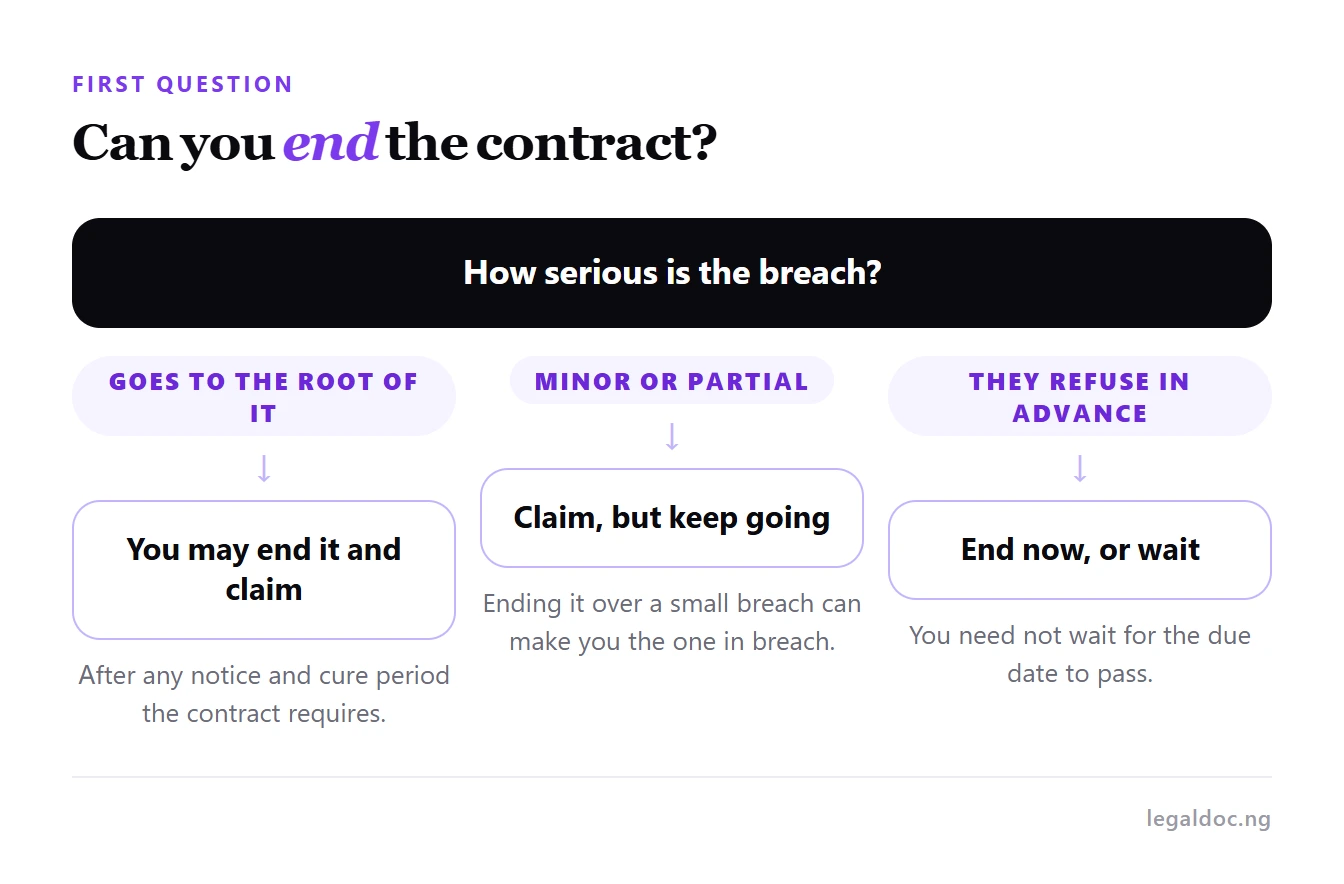
Ending a contract over a minor breach can make you the party in breach.
Check the contract first. Many contracts give a defaulting party a period to put things right after written notice, and require that notice before termination. Skipping it can turn a strong position into a weak one. If you do decide to end the contract, do it clearly and in writing, with a formal notice of termination.
The remedies, in plain terms
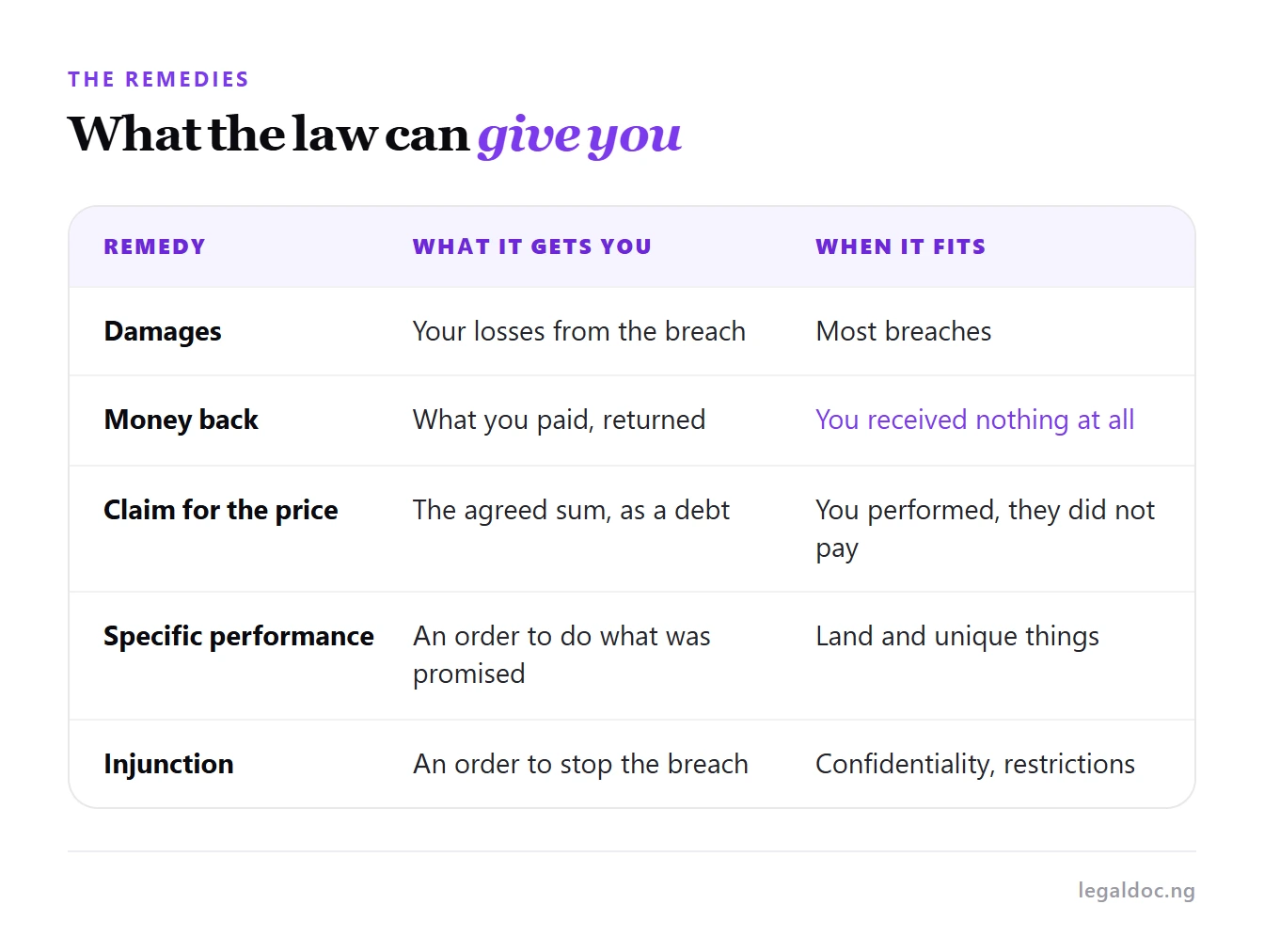
Most claims are for damages or for money paid. The others are for special cases.
Damages
Damages aim to put you, as far as money can, in the position you would have been in if the contract had been performed. That means your actual losses that flow from the breach: the extra cost of getting the goods elsewhere, the income you lost because the work was not done, the cost of fixing defective work.
Two rules limit them. The loss must be the kind that arises naturally from the breach, or that both sides would reasonably have had in mind when they made the contract. And you must take reasonable steps to keep your loss down. If the supplier fails to deliver, you are expected to buy elsewhere, not to let your business stand idle and claim for every idle day.
In Nigerian courts, specific losses with a precise figure, known as special damages, must be specifically claimed and strictly proved with evidence. Receipts, invoices and bank records win these claims. Round numbers and estimates lose them.
Getting your money back
If you paid for something and received nothing at all, you can usually recover what you paid, without having to prove further loss. For a deposit paid to a supplier who never delivered, this is often the simplest and strongest claim available.
They broke the deal. Ask what you can claim
Upload the contract and describe what happened, and LegalDoc+ sets out your remedies under Nigerian law and the next steps.
Ask about my claimA claim for the price
If you performed and the other side has simply not paid, your claim is for the agreed price as a debt, which is more straightforward than a claim for damages. The fast-track routes for clear debts are set out in what happens after the demand letter.
Forcing performance or stopping a breach
Occasionally money is not enough. A court can order specific performance, requiring the other side to do what it promised, where damages would be inadequate: a sale of land is the classic example. It will not usually force somebody to work for you. A court can also grant an injunction to stop a breach, such as an ex-employee using your confidential information. Both are discretionary, so they are never guaranteed.
What you can and cannot claim
Expectations are where breach of contract claims most often go wrong.
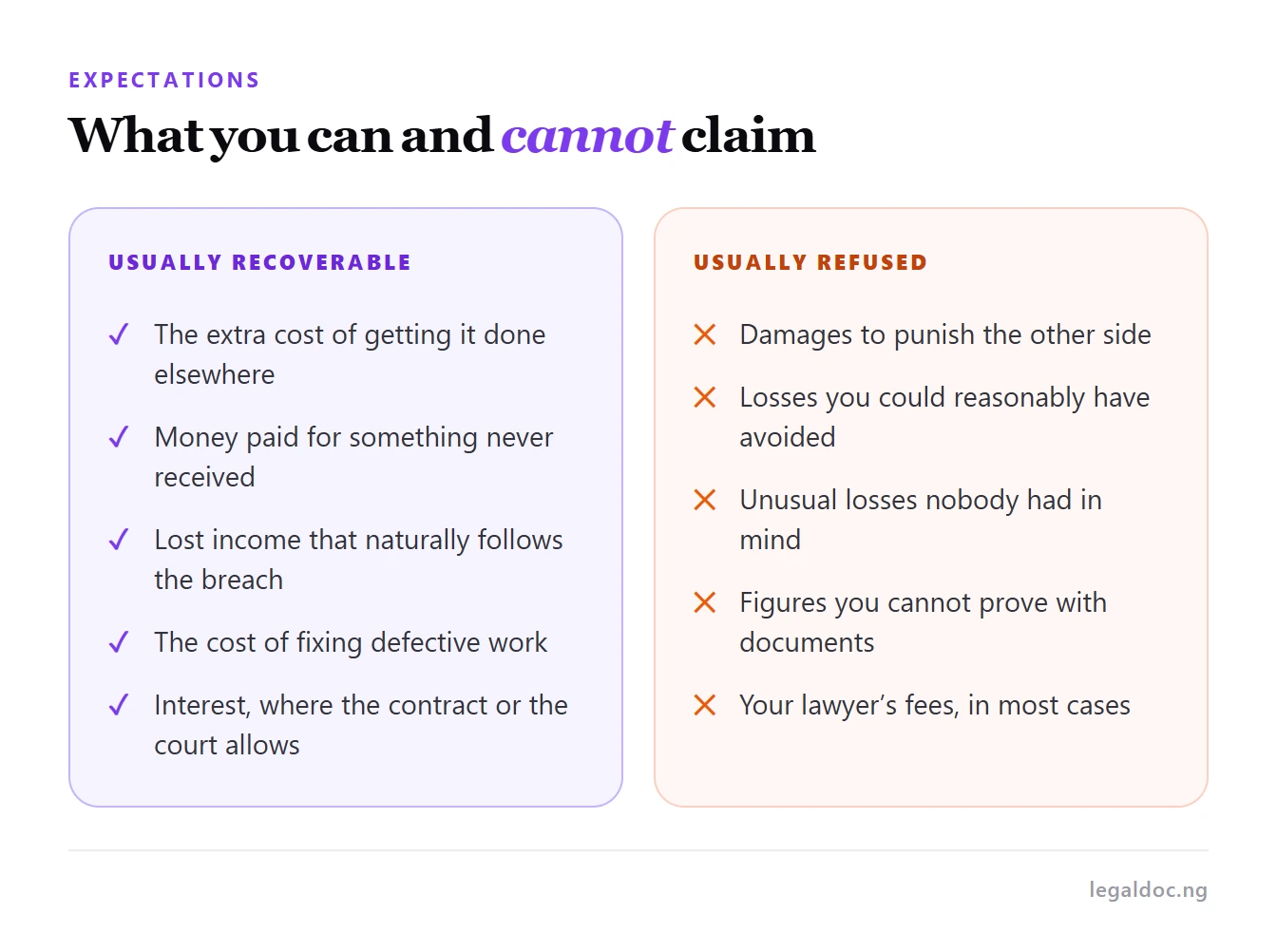
The contract can change this, in either direction.
Your contract may set a fixed sum payable for particular breaches, such as a daily charge for late delivery. Nigerian courts will enforce such a sum if it is a genuine estimate of the likely loss, but not if it is really a penalty. Equally, a limitation of liability clause may cap what you can recover or rule out lost profits altogether. We explain both in indemnity and limitation of liability.
What to do first
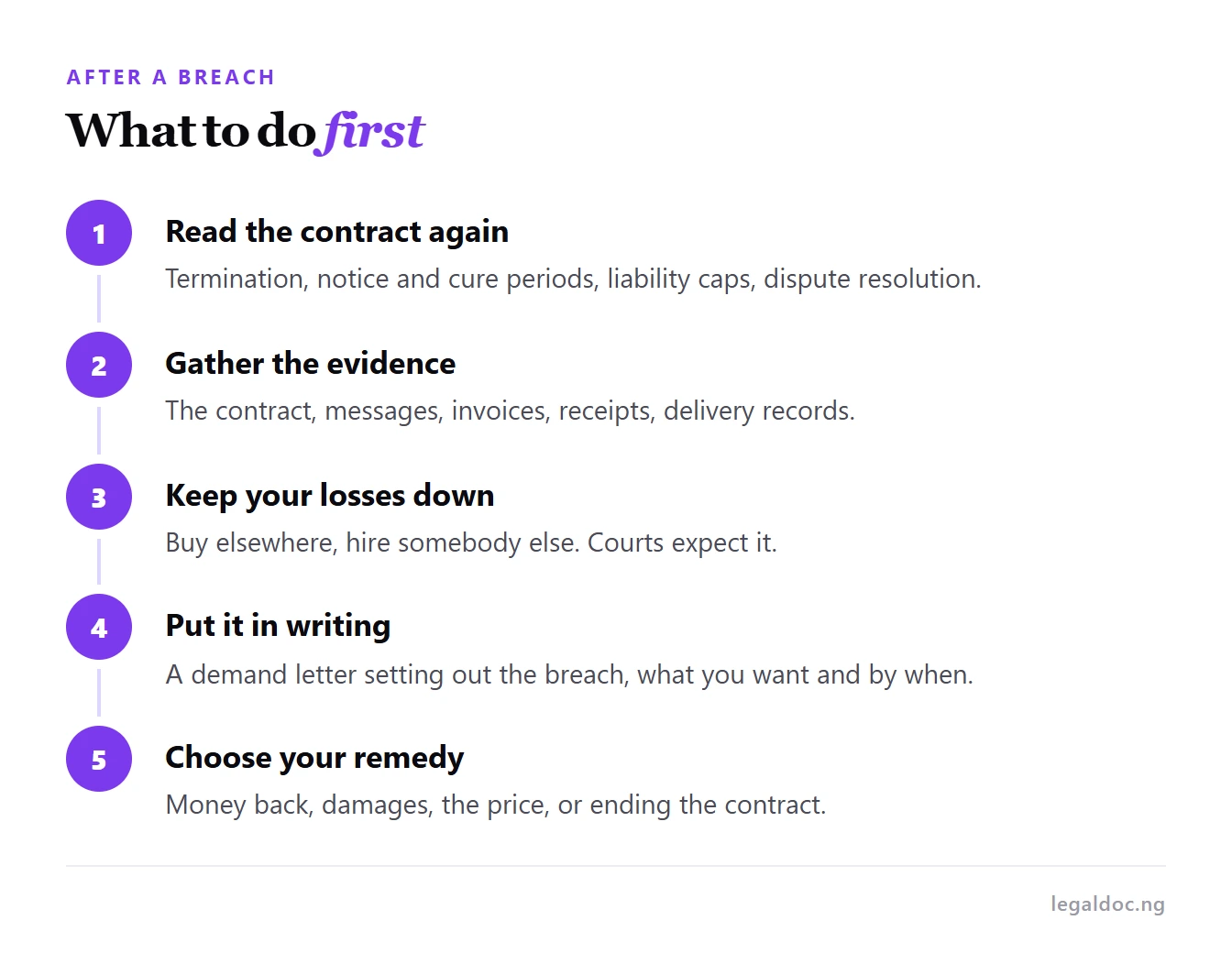
What you do in the first fortnight often decides the claim.
Put your position in writing early. A demand letter that sets out the contract, the breach, what you want and by when is often enough on its own, and if it is not, it becomes evidence. If you have received a demand and believe you were not in breach, a measured response to the demand letter protects your position.
Check the dispute resolution clause before going to court. If the contract requires mediation or arbitration first, a court will usually send you there.
Time limits
A claim for breach of a simple contract must generally be brought within six years of the breach. Do not let negotiations drift so long that you lose the right to sue.
Know where you stand before you act
The strength of any breach of contract claim depends on the exact words of the contract. Upload it to LegalDoc+ and describe what happened. It reads the termination, notice, liability and dispute clauses, tells you under Nigerian law whether you have a breach worth pursuing and what you can realistically claim, and sets out the next steps in order. If the next step is a letter, LegalDoc has the demand letter and notice of termination ready to complete.
And for the contracts you sign from now on, our contract review checklist helps make sure that if something does go wrong, the contract is on your side.
Frequently Asked Questions About Breach of Contract in Nigeria
What are the remedies for breach of contract in Nigeria? Damages, recovery of money paid where you received nothing, a claim for the agreed price, ending the contract for a serious breach, and in special cases specific performance or an injunction.
Can I end a contract because the other party breached it? If the breach is serious enough to go to the root of the contract, or the contract allows termination for that breach, yes. Follow any notice and cure period the contract requires, and give notice in writing.
Can I claim my lawyer's fees for a breach of contract? Generally not as damages. Nigerian courts are reluctant to make the other side pay your solicitor's fees, even where you win.
What is the time limit for suing for breach of contract in Nigeria? Generally six years from the date of the breach for a simple contract.
Do I have to prove my losses? Yes. Specific losses with a precise figure must be claimed specifically and proved with evidence such as receipts, invoices and bank records.
Where this leaves you
A breach of contract gives you real remedies, but not unlimited ones. Read the contract, keep your losses down, gather the evidence, and put your position in writing before you decide whether to end the contract or claim. The claims that succeed are the ones built on paperwork, not on anger.