

Selling or buying shares? Put the deal in writing
Price and how it is paid, warranties, indemnities and what each side delivers at completion, in a share purchase agreement.
Draft a share purchase agreementSomebody wants to buy your business. Maybe a competitor, maybe a bigger company that wants your customers, maybe a manager who has run it for years. You agree a number over lunch, and everybody shakes hands.
Then the lawyers ask a question that sounds technical but changes almost everything: are they buying the shares, or the assets?
The two are not just different paperwork. They decide who carries the old debts, whether your staff move across, whether contracts and land need fresh consents, and in many deals how much you actually take home. It is worth understanding before you agree a price, because the price usually assumes one or the other.
The short answer
In a share sale, the buyer buys the company itself from its shareholders, so everything the company owns and owes, including its staff, contracts, land and history, stays with it under new owners. In an asset sale, the company sells selected parts of the business, such as equipment, stock, brand and customer contracts, and keeps everything else, including its liabilities. Sellers usually prefer share sales for the clean exit. Buyers usually prefer asset sales so they can leave old problems behind.
Two very different things to buy
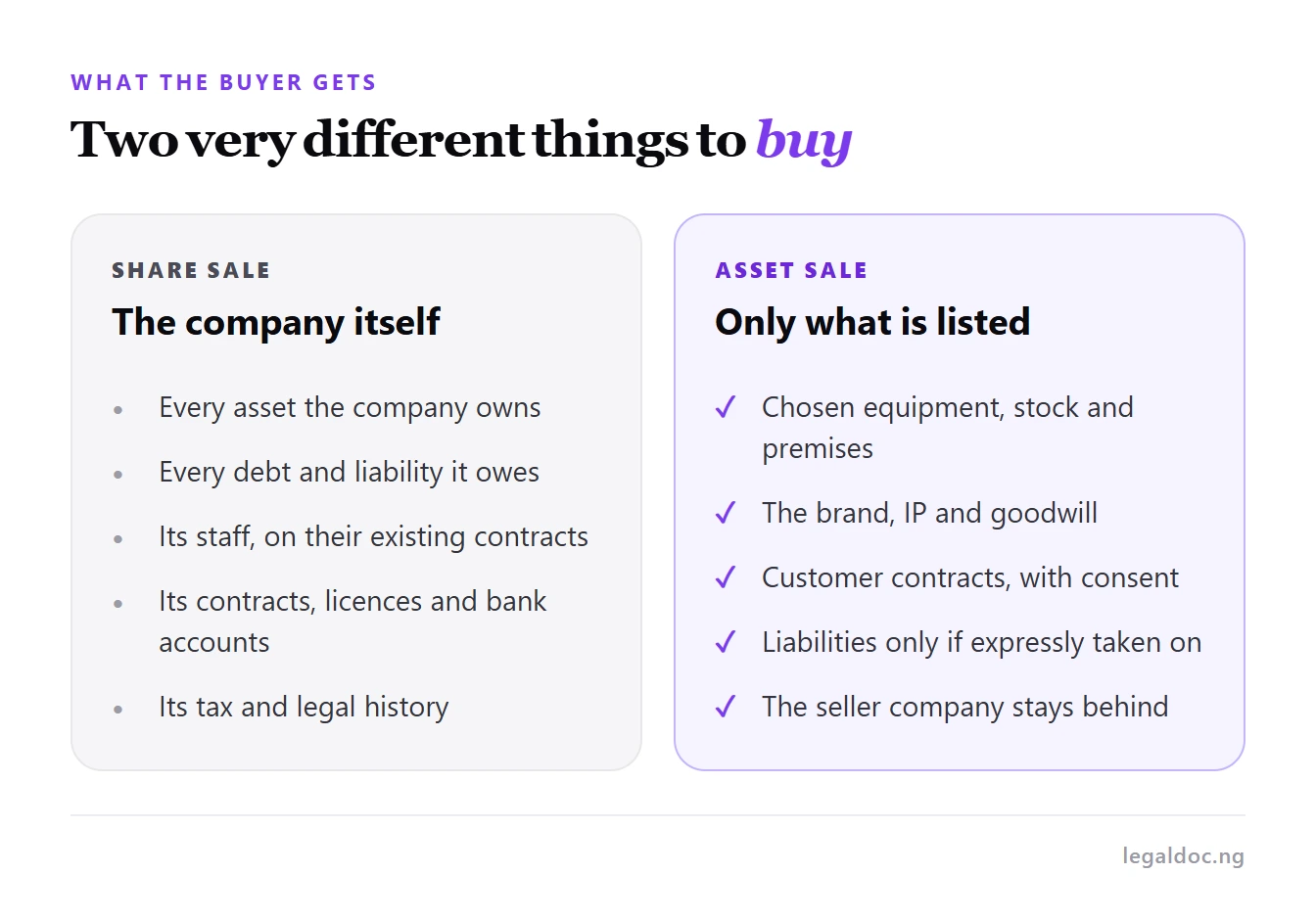
In a share sale nothing inside the company moves. In an asset sale, each thing moves on its own.
Share sale
A limited company is a separate legal person. When you sell its shares, the company does not change at all. It owns the same equipment, employs the same people, holds the same bank accounts and contracts, and owes the same debts. The only thing that changes is who owns it.
That makes the transaction itself simple: a share purchase agreement, signed share transfer forms, an update to the register of members and a notification to the CAC, including any change in persons with significant control.
Asset sale
In an asset sale, the company that owns the business sells some or all of what it owns to the buyer, usually the buyer's own company. The seller company stays in existence, with the sale proceeds and whatever it did not sell, including its liabilities, unless the buyer specifically agrees to take some on.
The catch is that every asset has to be transferred in its own way. Equipment and stock pass by delivery and a bill of sale. Land needs a deed of assignment and the Governor's consent. Trademarks need an assignment recorded at the Trademarks Registry. Customer and supplier contracts usually need the other party's agreement. Licences and permits are often personal to the holder and may not transfer at all.
Side by side
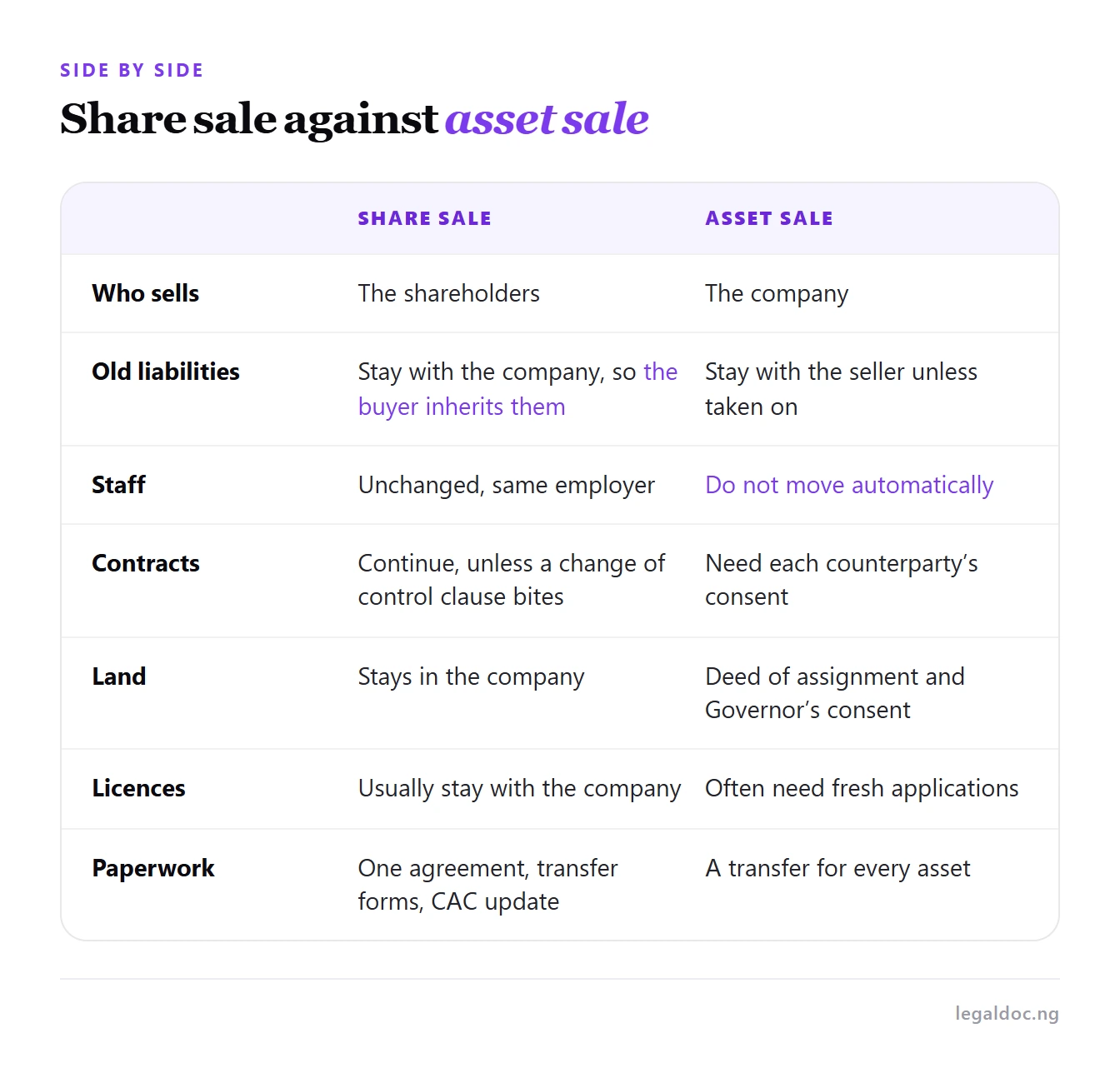
The row that surprises people most is the one about staff.
What each side usually wants
Sellers lean towards a share sale. It is a clean exit. Everything goes with the company, including the risks you would rather not carry after you have been paid, and there is one transaction instead of dozens of separate transfers.
Buyers lean towards an asset sale. They pick what they want, leave what they do not, and avoid inheriting the company's past: unpaid taxes, unremitted pension, old disputes, a contract somebody signed five years ago and forgot about.
Most negotiations land somewhere in between. A buyer who agrees to a share sale protects itself through investigation and the contract. A seller who agrees to an asset sale makes sure the price reflects the work and the liabilities left behind.
The staff question
This is the part that catches Nigerian sellers out.
In a share sale, nothing happens to employment. The company is still the employer, so contracts, salaries, accrued leave and length of service carry on exactly as before.
In an asset sale, the employees work for the seller company, and Nigeria has no general law that automatically moves them to the buyer with the business. A contract of employment is personal and cannot be handed to a new employer without the employee's agreement. So in practice, either the staff agree to move to the buyer on new contracts, or the seller ends their employment and the buyer rehires the ones it wants.
If the seller ends employment, it must do so lawfully, and for workers covered by the Labour Act that means following the redundancy procedure we explain in redundancy in Nigeria. It also means settling every outstanding salary, pension and tax remittance first, which is where unremitted payroll deductions tend to come to light.
Buying or selling a business? Ask which structure suits the deal
Describe the business and the deal, and LegalDoc+ explains the share and asset routes and what to watch for.
Ask LegalDoc+Which one fits your situation
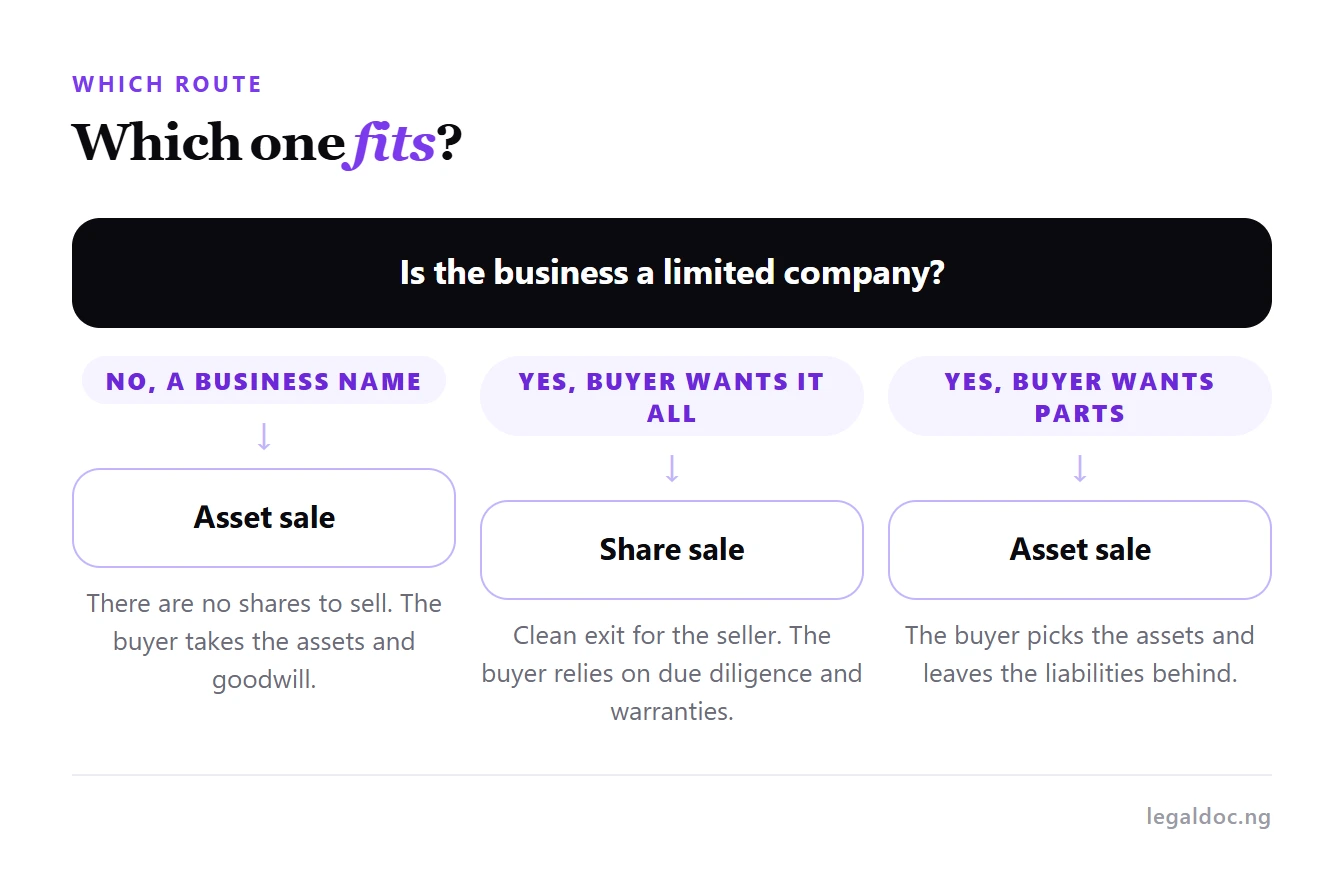
A registered business name has no shares, so the choice is made for you.
If your business is a registered business name rather than a limited company, there are no shares to sell. Any sale is an asset sale, and the buyer will either register a change of proprietor with the CAC or register a name of their own.
Due diligence: what the buyer will look at
In a share sale especially, the buyer is taking on the company's whole history, so they will investigate it before they commit. Expect them to ask for:
- Corporate records. The register of members, CAC filings, and whether annual returns are up to date.
- Tax and payroll. Tax filings and clearance, and evidence that pension, PAYE and NHF have been remitted every month.
- Contracts. Especially any that end, or need consent, if the company changes hands. Leases, loans and distribution deals often contain these change of control clauses.
- Property and assets. Title documents for land, and proof the company actually owns the equipment and IP it uses.
- Disputes. Pending or threatened claims, by customers, staff or regulators.
Sellers who prepare this in advance sell faster, and often for more, because every gap the buyer finds becomes a reason to lower the price or hold some of it back.
The contract that holds it together
Whichever route you take, the deal lives in the sale agreement. For a share sale that is a share purchase agreement, and the clauses that matter most are:
- Warranties. Statements by the seller about the company: its accounts are accurate, its taxes are paid, there are no undisclosed disputes. If one turns out to be false, the buyer can claim.
- Indemnities. Specific promises to cover specific risks the buyer has found, such as a known tax exposure, naira for naira.
- Price mechanics. Whether all the money is paid on completion, or some is deferred, linked to future performance, or held back for a period to cover claims.
- Restrictions on the seller. A buyer paying for goodwill will want the seller not to open a competing business next door. A reasonable non-compete, limited in time, area and scope, is normal.
Before any of that, most deals start with a letter of intent setting out the headline terms, and a non-disclosure agreement so the buyer can look at your books without walking away with them.
From handshake to completion
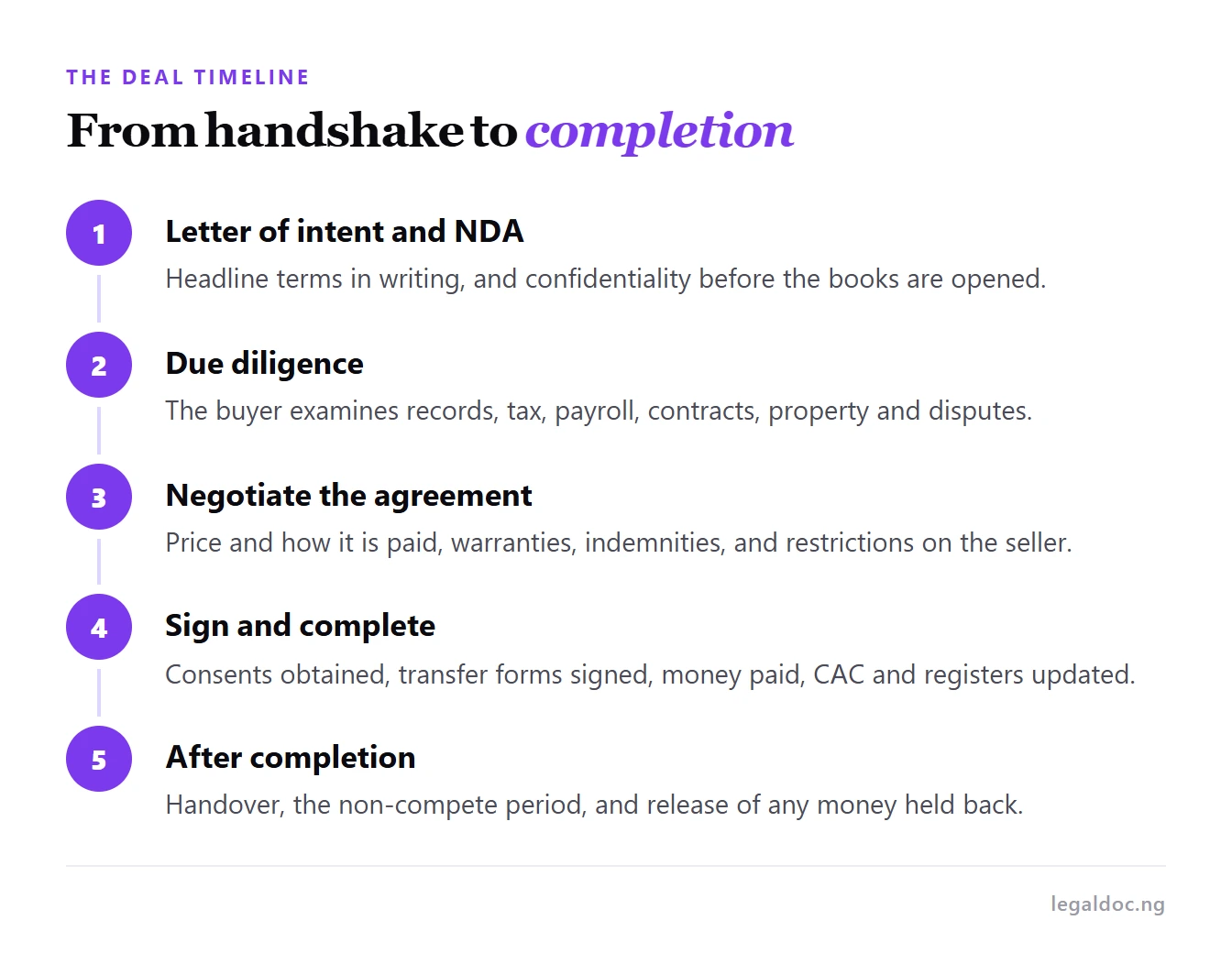
The middle two stages take the longest. Preparing your records shortens both.
Tax and approvals
Capital gains, stamp duties and VAT are treated differently in a share sale and an asset sale, and the rules were reworked under the tax reforms that took effect in January 2026. We have deliberately not quoted rates. Get tax advice on your actual figures before you agree the structure, because the structure can change what you take home more than a small movement in the headline price.
Larger deals may also need approval from the Federal Competition and Consumer Protection Commission before they complete, depending on the turnover of the businesses involved. Check the current thresholds early, because completing a notifiable deal without approval can attract heavy penalties and leave the deal without legal effect.
Frequently Asked Questions About Selling a Business in Nigeria
What is the difference between a share sale and an asset sale? In a share sale the buyer buys the company itself, with everything it owns and owes. In an asset sale the company sells selected assets of the business and keeps the rest, including its liabilities unless the buyer agrees to take them.
Do employees transfer automatically when a business is sold in Nigeria? In a share sale they stay employed by the same company, so nothing changes. In an asset sale they do not move automatically. They must agree to join the buyer, or the seller ends their employment lawfully and the buyer rehires them.
Can I sell a business name in Nigeria? A business name has no shares, so you sell its assets and goodwill. The buyer then registers a change of proprietor with the CAC or registers a name of their own.
Does land owned by the company need Governor's consent in a share sale? Generally not, because the company still owns the land and only its shareholders change. In an asset sale, land is transferred by deed of assignment and needs the Governor's consent.
Which is better for the seller? Usually a share sale, because liabilities leave with the company and the transaction is simpler. Buyers usually prefer an asset sale for the opposite reason.
Where this leaves you
Agree the structure before you agree the price, because each one assumes the other. Get your records in order before a buyer looks at them, and put the deal in a proper written agreement with warranties, a clear payment mechanism and sensible restrictions. The difference between a smooth sale and a painful one is usually decided long before anybody signs.