

Lent money on a handshake? Put it in writing now
A loan agreement records the amount, the interest, the repayment dates and what happens if payments stop.
Draft a loan agreementYou agreed it on the phone. Or in his office, over a handshake, with a mutual friend in the room. Supply two hundred bags, half the money now, half on delivery. You delivered. Now he says the price was lower, or that he never ordered that many, or that he does not remember the conversation at all.
Most Nigerian business still runs this way, on trust and phone calls, and most of the time it works. When it does not, the question is whether a verbal agreement is worth anything. The good news is that, in most cases, it is a real contract. The harder part is proving what was said.
The short answer
A verbal agreement is generally binding in Nigeria if it has the ingredients of any contract: an offer, an acceptance, something given in return, an intention to be legally bound, and terms clear enough to enforce. Some contracts must be in writing, including sales of land, guarantees, hire purchase and assignments of copyright. The weakness of a spoken deal is proof, so back it up immediately: a confirmation message setting out the terms, payments with clear narrations, and records of delivery.
When a verbal agreement is a contract
A contract does not have to be on paper to be a contract. Nigerian courts enforce oral agreements every day. What matters is whether the ingredients were there when you shook hands.
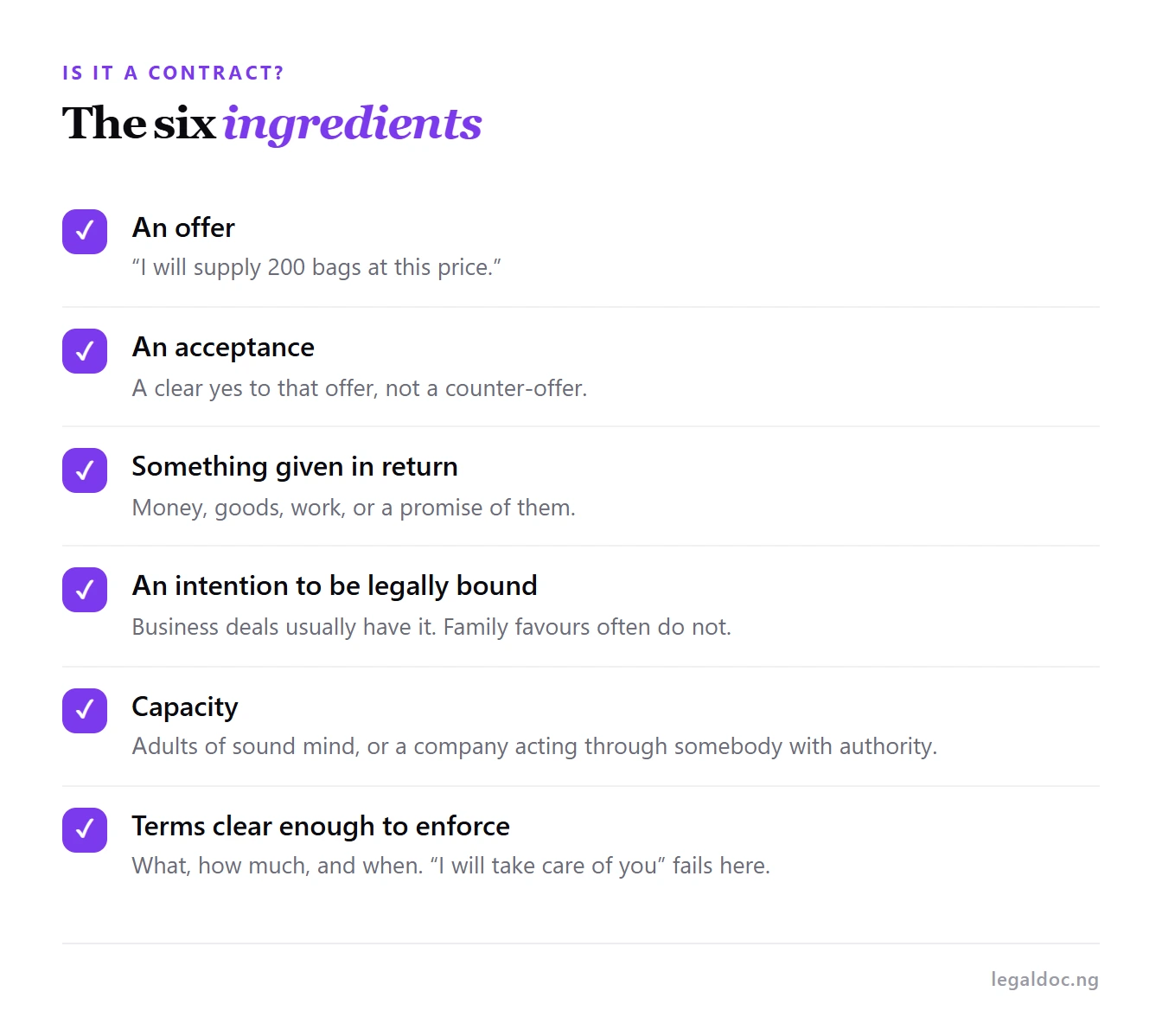
If all six are present, the absence of paper does not stop it being a contract.
The ingredient that most often fails is certainty. "I will take care of you when the money comes" is not a contract, because nobody can say what was promised. "I will pay you ₦600,000 for the logo and brand guide, half now and half on delivery by the end of the month" is.
The other one to watch is intention. Arrangements between family members and close friends are often treated as social rather than legal, unless the circumstances show both sides meant business. A loan to a cousin with no terms agreed can be very hard to recover for exactly this reason, which is why we always suggest a simple loan agreement even within a family.
The agreements that must be in writing
For some kinds of deal, the law does not accept a handshake. These are the ones that catch people out.
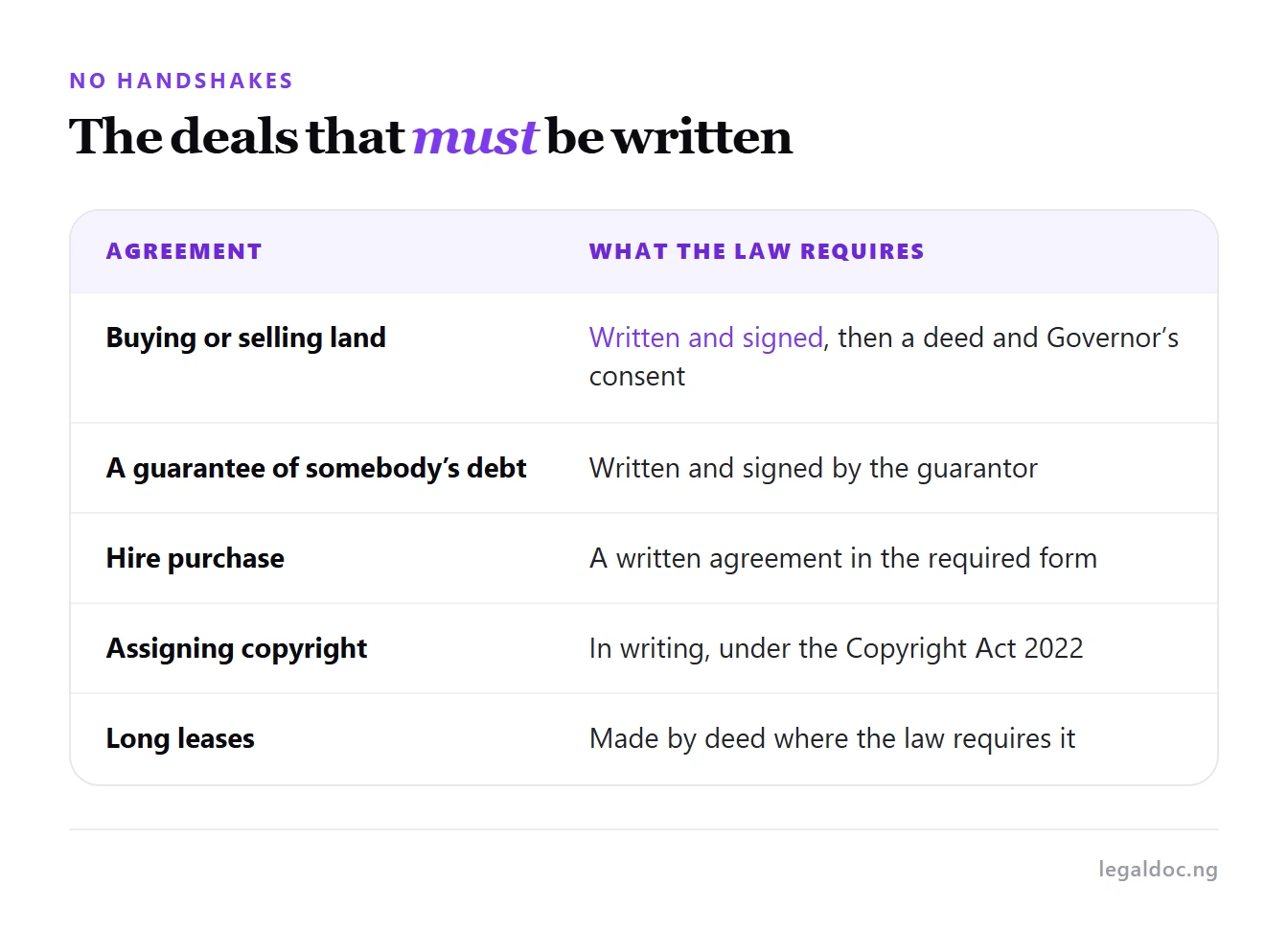
For these, a verbal agreement may give you nothing you can enforce in court.
Land. A contract to sell or buy land, or any interest in land, must be evidenced in writing and signed, under the rules that apply across Nigeria's states. Paying for land on a verbal promise is one of the most expensive mistakes people make, and the transfer itself then needs a deed of assignment and the Governor's consent.
Guarantees. A promise to pay somebody else's debt if they do not must be in writing and signed by the guarantor. "Don't worry, I'll stand for him" is not a guarantee you can enforce. A personal guarantee is.
Assigning copyright. Under the Copyright Act 2022, an assignment of copyright must be in writing. A designer who agreed on the phone that you would "own the logo" may still own the copyright.
Proving a verbal agreement
If a verbal agreement ends up in dispute, the person relying on it has to prove it, and its terms. Courts do not decide these cases on one person's word against another's. They look at everything around the conversation: what each side did afterwards, what was paid, what was written in messages, and who else was there.
Only agreed it verbally? Ask what you can prove
Describe the deal and the messages you have, and LegalDoc+ explains whether it is enforceable and how to firm it up.
Ask LegalDoc+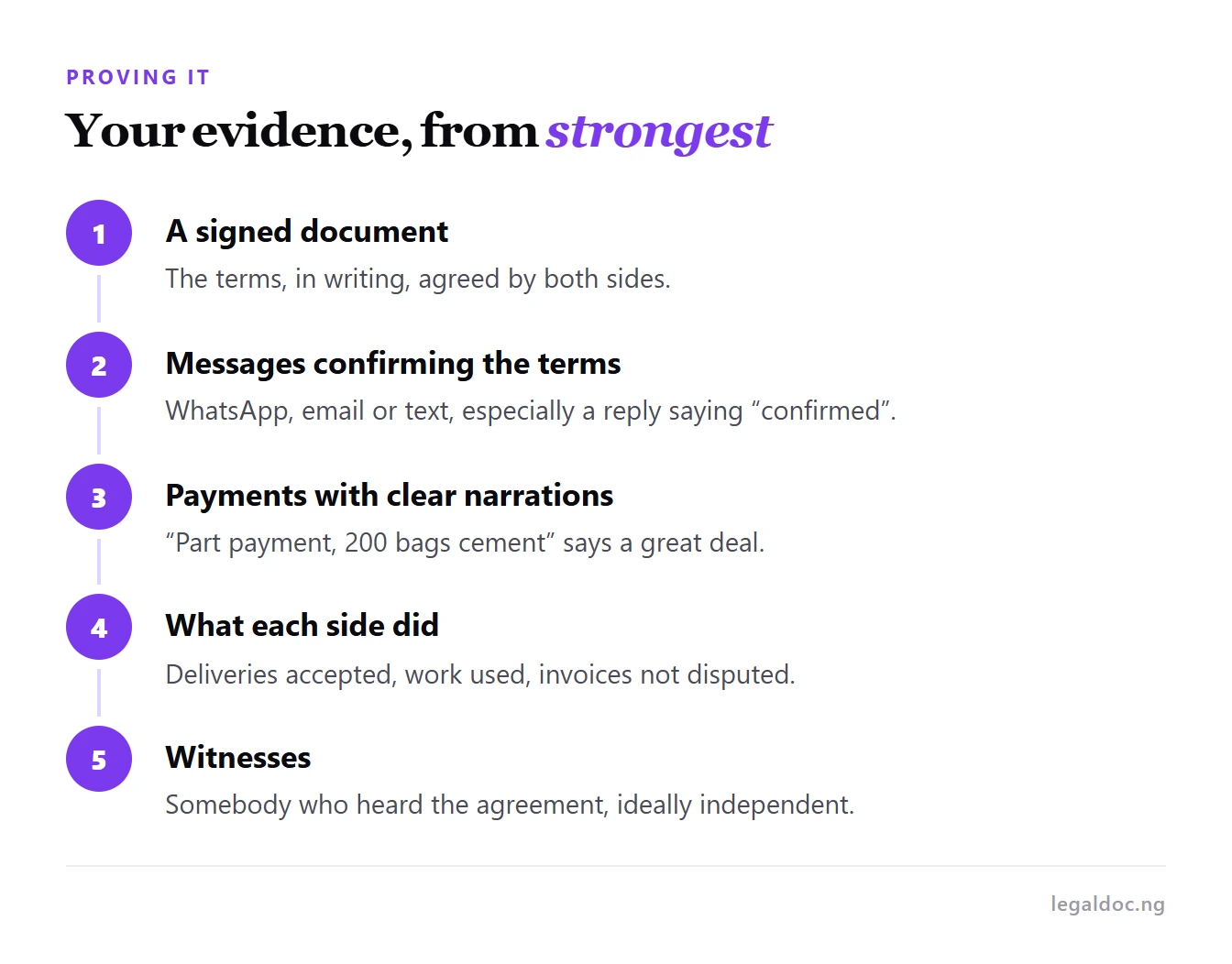
The further down this list your best evidence sits, the harder your case.
Conduct is powerful evidence. If you delivered two hundred bags, he accepted them, and he paid half the price you say was agreed, it becomes very hard for him to say there was never a deal. Payments with a clear narration, "Part payment, 200 bags cement", are better still.
WhatsApp messages, emails and even voice notes can be used as evidence, provided they meet the Evidence Act's requirements for electronic evidence. Do not delete chats, and export anything important. We look at how electronic records are treated in electronic signatures in Nigeria.
The message to send after every verbal deal
The single most useful habit in Nigerian business costs nothing. When you agree something verbally, send a short message the same day setting out what you agreed, and ask the other side to confirm.
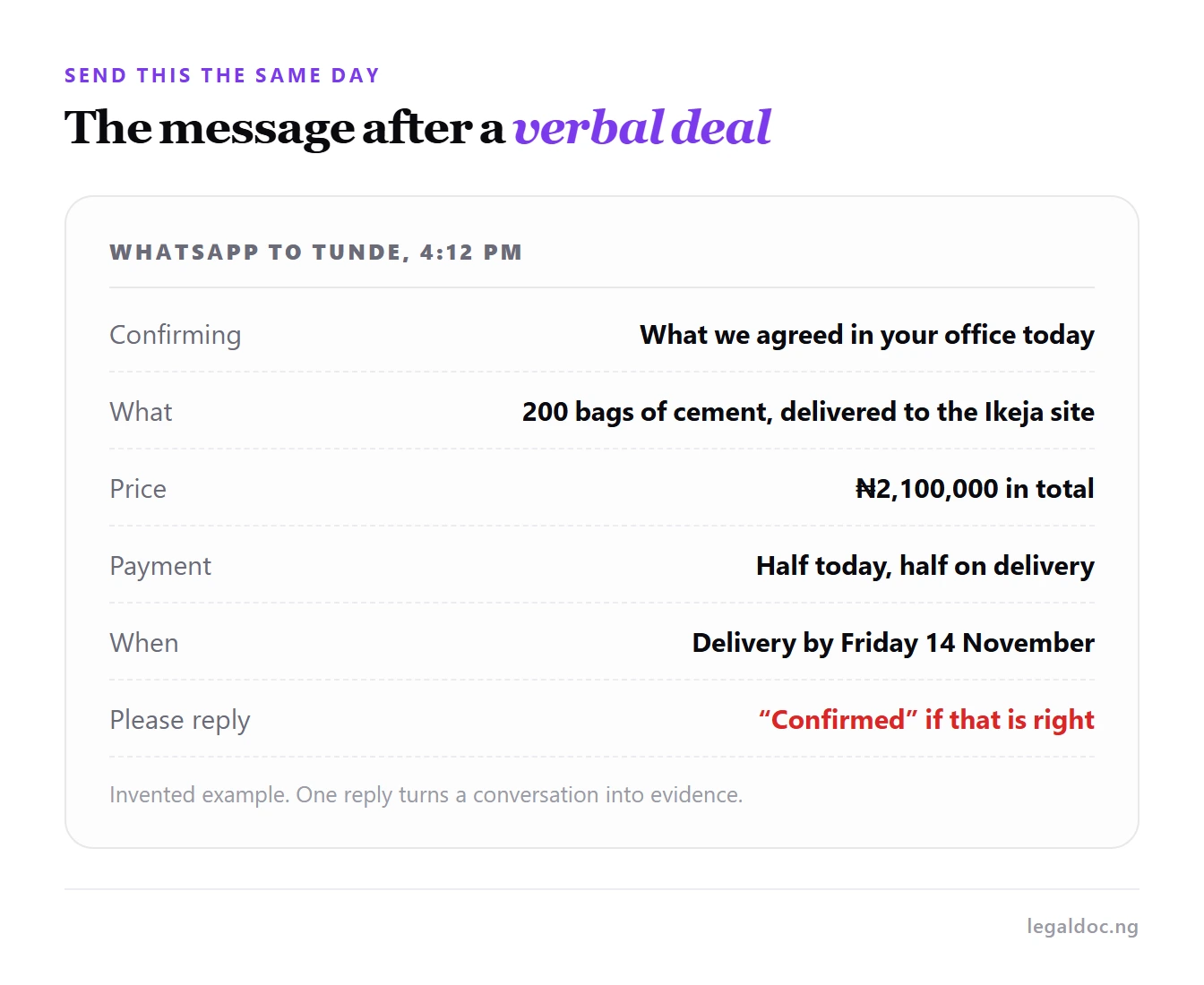
An invented example. One reply saying "confirmed" turns a conversation into evidence.
If they confirm, you have the terms in writing from both sides. If they reply correcting something, you have found the misunderstanding now, while it is cheap. And if they say nothing but go ahead anyway, their silence and their conduct together still tell a court a great deal.
When a verbal agreement goes wrong
If the other side denies the deal or will not pay, start by gathering every piece of evidence: messages, transfer receipts, delivery notes, the names of anybody present. Then put your understanding of the agreement in writing to them in a formal demand letter, which also becomes evidence in its own right.
A claim on a verbal agreement is a claim on a simple contract, so the general six-year limitation period applies from when the breach happened. The routes to recovery are the same as for any unpaid debt, which we set out in what happens after the demand letter.
Turning handshakes into documents
The point is not to stop doing business on trust. It is to write the trust down while everybody still agrees. A one-page document signed on the day costs far less than a dispute a year later.
LegalDoc has ready documents for the deals people most often leave verbal: a loan agreement for money lent to friends and family, a freelance agreement for work done for clients, a sale of goods agreement for supplies, and a partnership agreement for the business you started with a friend. Answer a few questions and download it ready to sign.
Already in a disagreement about what was said? Describe the deal to LegalDoc+ and it tells you, under Nigerian law, whether what you agreed is likely to be enforceable, what evidence will matter most, and what to do next. And if your deal is one it cannot fit into an existing template, it will draft the agreement for you.
Frequently Asked Questions About Verbal Agreements in Nigeria
Is a verbal agreement legally binding in Nigeria? Generally, yes, if it has an offer, an acceptance, something given in return, an intention to be legally bound and clear terms. Some contracts, such as sales of land and guarantees, must be in writing.
Which contracts must be in writing in Nigeria? Contracts for the sale of land or an interest in it, guarantees of another person's debt, hire purchase agreements, assignments of copyright, and leases that the law requires to be made by deed.
Can WhatsApp messages prove a verbal agreement? Yes. Messages, emails and voice notes can be evidence of what was agreed, provided they meet the Evidence Act's requirements for electronic evidence. Keep and export them.
How long do I have to sue on a verbal agreement? Generally six years from the breach, the same as for a written simple contract.
What if the other person denies there was any agreement? The court looks at the surrounding evidence: payments, deliveries, messages, witnesses and how both sides behaved. The more of that you have, the stronger your position.
Where this leaves you
A verbal agreement is usually a real contract in Nigeria, but it is only as good as your ability to prove it. Know which deals must be written, send a confirmation message after every handshake, and for anything that matters, put it in a signed document while everybody still remembers the same conversation.